

The right IP rating for a through bore slip ring depends on the actual exposure around the rotating assembly, not on choosing the highest number available.
Protected indoor machinery may only require IP40 to IP54. Equipment exposed to outdoor dust and rain often starts at IP65 or IP66. Temporary immersion points toward IP67, while an IP68 requirement must define the expected depth, duration and operating condition. High-pressure washdown is a separate case and may require IP69, IPX9 or IP69K protection under a named standard.
Before selecting a waterproof through bore slip ring, define what reaches the unit, where it can enter, whether the slip ring is rotating during exposure and how the claimed protection will be verified. The IP code is only one part of that decision.
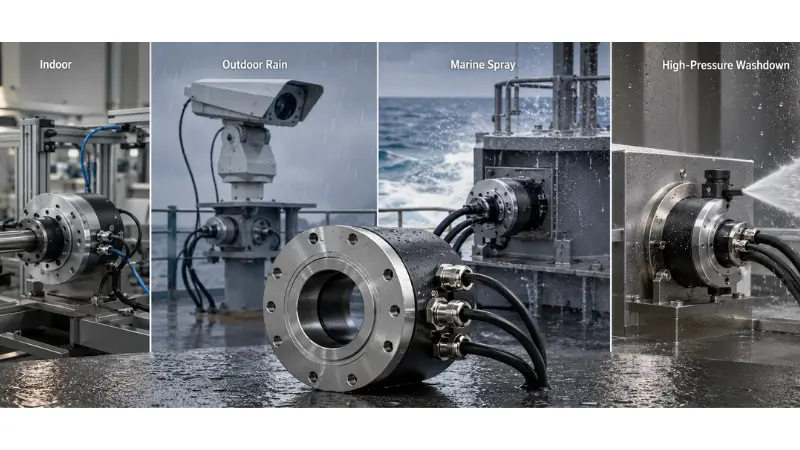
Quick Guide: Which IP Rating Does Your Slip Ring Need?
| Application condition | Main exposure | Typical starting point | Additional requirement to check |
|---|---|---|---|
| Protected indoor automation | Touch, light dust, no washdown | IP40–IP54 | Condensation, conductive dust and enclosure protection |
| General industrial equipment | Dust, oil mist, occasional splash | IP54–IP65 | Cable gland sealing and cleaning method |
| Outdoor camera, robot or antenna | Rain, dust and temperature cycling | IP65–IP66 | Drainage, UV exposure, corrosion and mounting direction |
| Marine deck equipment | Heavy spray, salt mist and humidity | IP66–IP67 | Corrosion resistance and connector sealing |
| Temporary immersion risk | Short-term submersion | IP67 | Specified immersion test and production configuration |
| Underwater or subsea equipment | Extended immersion and external pressure | IP68 | Depth, duration, pressure, rotation state and cable termination |
| High-pressure washdown | Close-range, high-pressure or hot water jets | IP69, IPX9 or IP69K | Exact standard, water temperature, pressure, distance and spray angles |
This table is a screening tool, not a substitute for engineering review. The final configuration must also match bore size, current, voltage, signal type, speed, duty cycle, torque limit and available installation space. These parameters can be reviewed alongside the site's through-hole slip ring specification guide and the available through-hole slip ring range.
What Does an IP Rating Mean?
IP stands for Ingress Protection. The code classifies the protection provided by an enclosure against access to hazardous parts, solid foreign objects and water.
The IEC explanation of IP ratings provides the basic interpretation, while IEC 60529 defines the enclosure protection system and its verification requirements.
- The first digit relates to access and solid-object protection. A first digit of 5 means dust-protected, while 6 means dust-tight under the applicable test.
- The second digit relates to water exposure, including splashing, jets and immersion under defined conditions.
For example, IP65 indicates a dust-tight enclosure with protection against water jets. IP67 adds protection against temporary immersion under the applicable test. IP68 covers immersion conditions beyond IP67, but the relevant depth and duration are not communicated by the two digits alone. Those conditions must be stated by the manufacturer.
Buyer warning: "Waterproof" is a marketing description, not a complete engineering specification. Rain, powerful jets, temporary immersion, continuous immersion and hot washdown are different exposures.
Where Does IP69K Fit?
The term IP69K is frequently used for equipment exposed to high-pressure, high-temperature water jets. However, buyers should confirm the named standard rather than relying on the suffix alone.
ISO 20653:2023 defines IP protection for electrical equipment in road vehicles. Other equipment may be specified using IEC 60529 terminology, including IPX9. When a supplier writes "IP69K," the test report should identify the exact standard, test edition, specimen and conditions.
Why Through Bore Slip Rings Are More Difficult to Seal?
A through bore slip ring has a central opening for a shaft, pipe, cable bundle or other rotating structure. That opening makes installation flexible, but it also creates more interfaces where contamination can enter.
The Rotating Shaft Interface
The central bore is not simply an opening in a stationary box. The surrounding assembly rotates, and the seal must tolerate shaft runout, misalignment, vibration and dimensional change without losing contact or creating excessive drag.
A seal that performs well during a stationary water test may behave differently after extended rotation. Lip wear, shaft eccentricity or debris on the sealing surface can create a leakage path that was not present when the unit was new.
Housing Seams and Flanges
Housing joints, flange faces and fastener locations need continuous compression around their sealing elements. Uneven mounting, damaged gasket surfaces or distortion from overtightened fasteners can reduce protection even when the housing design itself is sound.
Cable Exits and Connectors
The cable exit is often the weakest point. Water may travel through a loose gland, along the cable jacket or through an inadequately sealed connector. A high enclosure rating is not meaningful if the production cable termination was excluded from the tested assembly.
Condensation Inside a Sealed Unit
Rain is not the only moisture risk. Temperature cycling can cause internal air to contract and expand, and humid air may condense on contacts or insulation. The site's guide to the effects of temperature and humidity on slip ring performance explains why condensation, corrosion and insulation degradation must be assessed separately from direct water entry.
Mounting Direction and Water Collection
A horizontal slip ring may retain water around a flange or cable entry. A vertically mounted unit may allow water to run down the cable toward the housing. Drainage, drip loops, covers and cable routing therefore form part of the protection system.
Before installation, review the site's through-hole slip ring installation instructions, then confirm that the actual mounting arrangement matches the configuration evaluated by the manufacturer.
Common Sealing Methods in a Waterproof Through Bore Slip Ring
A sealed through bore slip ring may use several measures together. No single sealing component solves every exposure.
| Design measure | Main function | Important limitation |
|---|---|---|
| Static O-rings or housing gaskets | Seal housing joints and flange interfaces | Require correct compression and undamaged mating surfaces |
| Dynamic lip or shaft seals | Seal around a rotating shaft interface | Add friction and wear; depend on shaft finish and runout |
| Labyrinth features | Make the ingress path longer and reduce direct contamination | Usually support rather than replace a positive water seal |
| Potted cable exits | Block moisture movement around conductors | Reduce field repairability and require material compatibility |
| Sealed cable glands or connectors | Protect the external electrical interface | Must be rated and installed as part of the complete assembly |
| Corrosion-resistant housing and hardware | Reduce material degradation in wet or saline environments | Does not by itself establish an IP rating |
| Pressure equalization device | Reduce pressure differences during environmental cycling | Its water, dust and chemical compatibility must be confirmed |
A representative waterproof through-hole slip ring configuration shows how sealed housing interfaces, cable entries and corrosion-resistant materials may be combined. The stated rating still needs to be confirmed for the exact circuit, cable, connector and mounting configuration being purchased.
IP54 vs IP65 vs IP66 vs IP67 vs IP68 vs IP69K
| Rating | Protection summary | Best suited to | Not enough when | Question for the supplier |
|---|---|---|---|---|
| IP54 | Dust-protected and protected against splashing water | Protected indoor machinery with limited splash exposure | There is heavy dust, direct rain, washdown or condensation risk | What surrounding enclosure and installation conditions were assumed? |
| IP65 | Dust-tight and protected against water jets | General outdoor equipment and moderate industrial cleaning | The equipment faces powerful jets or immersion | Were the production cables, glands and connectors included in the test? |
| IP66 | Dust-tight and protected against powerful water jets | Exposed outdoor systems, heavy rain and strong spray | Temporary or extended immersion is possible | Was the unit tested from all relevant directions? |
| IP67 | Dust-tight and protected against temporary immersion | Equipment with a defined short-term submersion risk | The unit must remain underwater for longer or at greater pressure | What immersion condition and post-test acceptance criteria were used? |
| IP68 | Dust-tight and protected under agreed extended immersion conditions | Underwater equipment with specified depth and duration | The exposure is high-pressure washdown rather than immersion | What depth, duration, pressure and operating state were tested? |
| IP69, IPX9 or IP69K | Protection against close-range, high-pressure and potentially high-temperature jets under the named standard | Vehicle, sanitation or washdown applications with defined jet exposure | The equipment must withstand extended immersion or corrosive chemicals | Which standard edition, water temperature, pressure, distance and spray angles apply? |
Static IP Testing vs Real Rotating Operation
An IP rating is an enclosure verification result. It does not automatically describe every condition the slip ring will experience during its service life.
For a rotating electrical connector, ask whether the claimed protection was verified:
- while the slip ring was stationary or rotating;
- before or after a rotational endurance test;
- with the production shaft, cables, glands and connectors installed;
- in the same horizontal or vertical mounting orientation;
- after temperature cycling, vibration or seal aging;
- using a standard production unit or a specially prepared test sample.
A static IP test can demonstrate enclosure protection under the test conditions. It does not by itself establish seal life, running torque, electrical noise or long-term resistance to vibration and thermal cycling.
Engineering note: For a critical outdoor, marine or underwater application, request both ingress-protection evidence and operating validation. The unit should still meet relevant electrical and mechanical acceptance criteria after environmental exposure.
How to Choose the Right IP Rating Step by Step?
Step 1: Describe the Solid Contamination
Do not write only "dusty." Identify the material and how it reaches the slip ring:
- ordinary indoor dust;
- fine sand;
- cement or mineral dust;
- metallic or conductive particles;
- agricultural debris;
- abrasive powder;
- oil-contaminated dust.
Conductive and abrasive contamination can create different risks from ordinary non-conductive dust. It may damage a seal surface, contaminate bearings or create unstable electrical paths.
Step 2: Define the Water Exposure
Replace "waterproof" with a measurable description:
- occasional splash;
- wind-driven rain;
- hose cleaning;
- high-pressure washdown;
- temporary flooding;
- continuous immersion;
- saltwater spray;
- condensation without direct rain;
- water containing detergent, chlorine, oil or process chemicals.
Water pressure, temperature, distance, direction, frequency and duration can change the required sealing design even when two installations appear to be in the same industry.
Step 3: Define Speed, Duty Cycle and Torque Limits
Higher sealing force can improve resistance to ingress, but a dynamic seal can also increase starting torque, running torque, heat and wear. This matters in low-torque positioning systems, sensitive camera platforms and continuously rotating equipment.
Provide the real speed profile rather than one maximum RPM value. Include starts, stops, oscillating motion, continuous rotation, daily hours and expected lifetime cycles. The broader slip ring configuration guide explains how circuit, load, signal, contact and mechanical requirements should be reviewed together.
Step 4: Check Materials Beyond the IP Code
An IP rating does not prove resistance to salt spray, ultraviolet radiation, coolant, cleaning chemicals or galvanic corrosion. Marine equipment may require stainless hardware, coated aluminum, compatible seal materials and controlled combinations of dissimilar metals.
For exposed coastal and offshore installations, review the separate guidance on corrosion protection for marine slip rings. IP protection and corrosion protection solve related but different problems.
Step 5: Review the Complete Rotating System
The slip ring may be installed inside another enclosure, below a protective cover or directly in the environment. Assess the complete assembly, including:
- shaft and flange interfaces;
- external connectors;
- cable glands and drip loops;
- drainage paths;
- adjacent bearings;
- covers and equipment doors;
- installation orientation;
- service access and maintenance procedures.
A lower-rated slip ring inside a properly protected cabinet may be more appropriate than a heavily sealed unit that adds unnecessary torque and cost. Conversely, an IP65 label cannot compensate for an open connector or water collecting around a mounting flange.
Step 6: Match the Rating to the Actual Application
| Application example | Likely starting point | Extra engineering requirement | Common failure point |
|---|---|---|---|
| Indoor packaging turntable | IP40–IP54, or IP65 when regularly cleaned | Film dust, cleaning method and low starting torque | Dust accumulation around cable exits |
| Outdoor PTZ surveillance unit | IP65–IP66 | Video or Ethernet integrity, UV, drainage and condensation | Water following the camera cable into the gland |
| Satellite or tracking antenna | IP65–IP66, depending on exposure | Low torque, signal shielding and temperature cycling | Flange pooling and cable-entry leakage |
| Industrial robot | IP54–IP67, depending on cell conditions | Repeated motion, vibration and signal-channel isolation | Seal wear caused by misalignment or oscillation |
| ROV or underwater sensor platform | Defined IP68 or project-specific pressure sealing | Depth, pressure, immersion duration and dynamic operation | Cable termination or pressure-related seal deformation |
| Marine deck mechanism | IP66–IP67 | Salt spray, galvanic corrosion and sealed connectors | Corrosion at hardware and connector interfaces |
| Food or beverage washdown equipment | IP66 or IP69/IP69K when the cleaning process requires it | Cleaning temperature, pressure, chemicals and hygienic geometry | Repeated jet impact on seals and cable entries |
For application-specific circuit and motion requirements, compare the site's guides for CCTV and PTZ slip rings, rotating antenna slip rings, and signal slip rings for robots, ROVs and UAVs.
Packaging equipment presents a different balance of dust, cleaning, signal and torque requirements. A practical example is the site's through-hole slip ring application for stretch wrappers.
Step 7: Ask for Verifiable Test Evidence
A supplier's IP claim should be traceable to a test configuration. Ask for a report or declaration that identifies:
- the applied standard and edition;
- the exact slip ring model and revision;
- the specimen quantity;
- the housing, shaft, cable, connector and gland configuration;
- the mounting orientation;
- the dust, water, immersion or jet conditions;
- whether the unit was stationary or rotating;
- pre-test and post-test inspection results;
- acceptance criteria for water entry;
- post-exposure insulation resistance and dielectric checks;
- post-exposure continuity, contact resistance or signal checks;
- any rotational test performed after exposure.
General electrical and mechanical checks are described in the site's guide on how to test a slip ring. For supplier evaluation, the slip ring quality management and testing process provides additional context on incoming inspection, electrical testing, dynamic resistance and environmental verification.
When a Higher IP Rating Is Not the Better Choice?
Over-specifying the protection level can create avoidable trade-offs.
Higher Running Torque
A tighter dynamic seal can increase drag. In a precision pan-tilt head, inspection table or small robot joint, the added torque may affect positioning, motor selection or control stability.
More Seal Wear
Dynamic sealing surfaces wear during rotation. A highly sealed design may require stricter shaft finish, concentricity, lubrication or replacement intervals.
Larger Housing
Additional seals, glands, pressure-management features and mechanical reinforcement can increase outer diameter or length.
More Difficult Maintenance
Potting and permanently sealed cable exits improve ingress resistance but can make field repair or cable replacement more difficult.
Unnecessary Cost
An IP68 design is not automatically useful inside a dry, guarded machine. The better specification is the lowest protection level that reliably covers the real exposure with an appropriate safety margin.
If no standard model combines the required bore, circuits, signal channels, speed, torque and environmental protection, evaluate a custom sealed slip ring rather than forcing an unsuitable standard unit into the application.
Common Specification Mistakes
Writing Only "Outdoor Use"
Outdoor conditions vary from a covered installation with humidity to direct rain, coastal salt mist, desert dust or winter freeze-thaw cycling. State the actual exposure.
Assuming IP68 Includes Powerful Water Jets
Immersion protection and jet protection are different test categories. Confirm both when the equipment can be submerged and pressure-washed.
Ignoring the Production Cable and Connector
A housing test performed with temporary plugs may not represent the delivered assembly. Request evidence for the final cable-entry configuration.
Treating Saltwater Resistance as an IP Rating
IP protection addresses ingress. It does not establish resistance to pitting, galvanic attack, coating damage or salt-related connector corrosion.
Ignoring Condensation
A unit can remain externally sealed and still experience internal condensation after temperature changes. Discuss pressure equalization, internal humidity and thermal cycling.
Ignoring Rotation During Environmental Exposure
A seal may pass a stationary test but wear or leak during prolonged operation. Critical applications need endurance and environmental validation that reflect the real motion profile.
Requesting the Highest Rating Without a Torque Limit
If low torque matters, state an acceptable starting and running torque rather than asking for maximum sealing without a mechanical limit.
What to Include in a Through Bore Slip Ring RFQ?
A useful RFQ should give the supplier enough information to review the complete electrical, mechanical and environmental design.
Mechanical Information
- required bore diameter;
- maximum outer diameter and length;
- shaft diameter, tolerance, finish and runout;
- mounting method and orientation;
- rotation speed and motion profile;
- starting and running torque limits;
- shock and vibration conditions;
- expected operating hours or lifetime rotations.
Electrical and Signal Information
- circuit count;
- continuous and peak current per circuit;
- AC or DC voltage;
- grounding requirements;
- encoder, thermocouple or low-level sensor circuits;
- Ethernet, CAN, RS-485, USB, HD-SDI or other named protocols;
- shielding, isolation and acceptable electrical-noise requirements.
Environmental Information
- operating and storage temperature;
- dust type and concentration;
- rain, spray, washdown or immersion condition;
- water pressure, temperature and cleaning frequency;
- immersion depth and duration;
- salt mist, oil, coolant, detergent or chemical exposure;
- condensation and thermal cycling;
- required IP code and named test standard.
Verification and Documentation
- required ingress-protection report;
- electrical test records;
- post-environment insulation resistance;
- rotational endurance requirement;
- material or coating documentation;
- inspection report and drawing approval;
- installation and maintenance instructions.
Attach the installation drawing, cable-exit direction and environmental specification whenever possible. For a project review, submit these details through the ByTune slip ring engineering contact page.
Frequently Asked Questions
Q: Is An IP65 Through Bore Slip Ring Waterproof?
A: IP65 indicates dust-tight protection and protection against water jets under defined test conditions. It is suitable for many outdoor applications, but it does not mean the unit can be submerged.
Q: What IP Rating Is Best For An Outdoor Slip Ring?
A: IP65 or IP66 is a common starting point for direct outdoor exposure, but the answer depends on rain intensity, spray, enclosure coverage, mounting orientation, drainage, condensation and corrosion. A covered outdoor installation may have different requirements from an exposed coastal antenna.
Q: What Is The Difference Between IP67 And IP68?
A: IP67 covers temporary immersion under its defined test. IP68 applies to immersion conditions beyond IP67, but the depth and duration must be specified. Ask the supplier to identify the exact conditions rather than accepting "IP68" by itself.
Q: Is IP69K Better Than IP68?
A: No. They address different exposure modes. IP68 relates to specified immersion, while IP69K or similar IPX9 claims relate to high-pressure jet exposure under a named standard. Some equipment may require both types of verification.
Q: Does A Higher IP Rating Increase Slip Ring Torque?
A: It can. Dynamic shaft seals and higher sealing pressure may increase starting torque, running torque, heat and wear. The amount cannot be assumed from the IP code; it must be measured for the selected design.
Q: Is IP68 Enough For Saltwater?
A: Not by itself. IP68 addresses ingress under specified immersion conditions. Saltwater applications also require suitable housing materials, coatings, hardware, cable glands, connectors and protection against galvanic and pitting corrosion.
Q: Does An IP Rating Apply While The Slip Ring Is Rotating?
A: Only if the supplier's verification or additional testing covers that operating condition. Ask whether the test was stationary or dynamic and whether the unit was retested after rotational endurance.
Q: Can A Sealed Through Bore Slip Ring Transmit Ethernet Or Encoder Signals?
A: Yes, when the electrical contact system, shielding, channel arrangement and cabling are designed for the required protocol. The IP rating and signal-performance specification should be validated separately.
Q: Can Every Standard Through Bore Slip Ring Be Upgraded To IP68?
A: Not automatically. Bore size, housing space, shaft interface, cable exits, torque limits, speed and maintenance requirements may prevent a simple sealing upgrade. Some projects require a different housing or a fully custom design.
Conclusion
Selecting a through bore slip ring IP rating starts with the exposure, not the number.
Use IP54 only when the unit is protected from heavy dust and direct water. Consider IP65 or IP66 for rain, dust and external spray. Use IP67 when temporary immersion is a defined risk. Specify IP68 only with an agreed depth, duration, configuration and operating condition. For high-pressure washdown, identify the exact IP69, IPX9 or IP69K standard and test parameters.
Then verify the entire assembly: rotating shaft interface, housing seams, cable glands, connectors, mounting orientation, corrosion resistance, condensation, torque and post-exposure electrical performance. A well-defined, testable specification is more reliable than requesting the highest IP rating on a datasheet.