


What is Capsule Slip Ring?
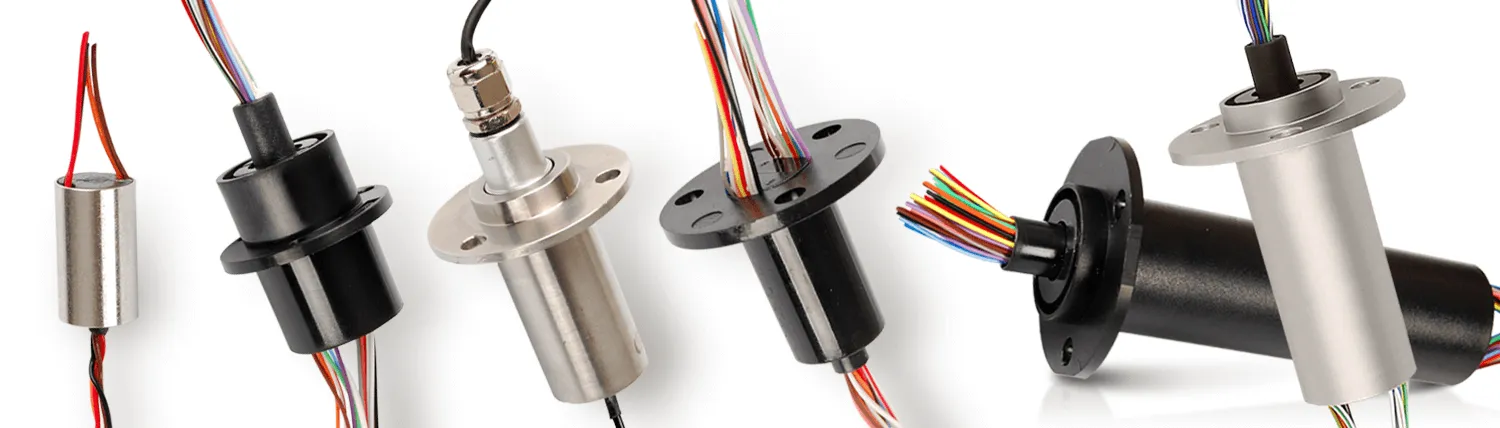
Capsule slip ring ,the name comes from it have a housing like a cap which with a flange for easier installation , it is a compact, enclosed type of slip ring designed to transfer electrical power and signals between a stationary and a rotating component. Due to its small size and integrated structure and made by tooling injection, it is particularly suitable for applications where space is limited and a high degree of reliability is required.
How Does the Capsule Slip Ring Work?
The basic working principle of capsule slip rings is to transmit current or signals through the sliding contact between brushes and conductive rings. When the rotating part of the equipment (inner shaft) turns, the conductive ring mounted on the inner shaft contacts the brush fixed on the outside (cap), thus maintaining the electrical connection during the rotational motion. The brushes slide as the conductive ring rotates, ensuring the continuous transmission of power or data signals without interruption due to rotation.

Key Components Of Capsule Slip Ring
The notable feature of the capsule slip ring is that its appearance is similar to a cap. The main structural components include:
Flange
The capsule slip ring has an outer flange, which is an important structural feature. There are fixing holes on the flange for connecting with the customer's equipment to achieve fixed installation of the outer layer.
Conductive ring
Located inside the slip ring, it directly participates in the transmission of current or signal. According to needs, it can be designed as a single-ring or multi-ring structure to meet the transmission requirements of different quantities and types of signals.
Brush assembly
Installed on the "brim" part of the cap-type slip ring, it keeps in contact with the rotating conductive ring. The brush material is usually a wear-resistant and conductive alloy, such as gold-plated graphite, to reduce wear and ensure low contact resistance.
Insulating material
The insulating material of the capsule slip ring is generally POM, which has high volume resistivity, large surface resistivity, high electrical strength, and is used to isolate each conductive ring, prevent crosstalk between signals, and provide necessary electrical isolation.
Support structure
Including bearings and other mechanical support components to ensure the smooth operation of the slip ring during rotation and reduce vibration and wear.
Protective measures
Including dust cover or sealing ring to protect the inside of the slip ring from environmental factors such as dust and moisture to extend the service life.
How to Choose the Right Capsule Slip Ring
Determine the usage scenario
Industrial automation: If applied to industrial automation equipment, it may be necessary to consider environmental factors such as vibration, dust, and oil that the slip ring can withstand. At the joints of some large mechanical arms, the slip ring needs to be able to work stably under frequent movements and large mechanical stresses, and at the same time be able to resist the erosion of dust and oil in the industrial environment.
Medical equipment: For capsule slip rings in medical equipment, higher reliability and stability are required, because medical equipment is directly related to the life and health of patients. In addition, the size and weight of the slip ring need to be considered to meet the compact design requirements of medical equipment.
Aerospace: In the field of aerospace, capsule slip rings need to have extremely high reliability, lightweight, and radiation resistance. Since aerospace equipment operates in harsh environments such as high altitude, high speed, and extreme temperature, the slip ring must be able to withstand these tests, and at the same time, it cannot add too much weight to avoid affecting the performance of the aircraft.
Size and installation method
Choose a capsule slip ring of appropriate size according to the space limitations and installation requirements of the equipment. Some equipment has compact space and needs to choose miniaturized slip rings; while some equipment may require specific installation methods, such as flange installation, thread installation, etc. Make sure the slip ring can be easily installed on the equipment and will not interfere with other components.
Speed requirements
Different equipment has different speed requirements for slip rings. Some rotating platforms may need to rotate at high speed, while some slowly rotating equipment have lower speed requirements. Choose a slip ring that can meet the speed requirements of the equipment to ensure that it will not be damaged due to excessive speed during operation.
Signal type
If you need to transmit various signals, such as digital signals, analog signals, RF signals, etc., you should choose a slip ring that can support these signal types. Different signal types have different electrical performance requirements for slip rings. For example, digital signals require slip rings to have low signal distortion and good anti-interference ability, while RF signals require slip rings to have good high-frequency characteristics and low insertion loss.
Voltage and current
Choose a suitable capsule slip ring according to the voltage and current required by the connected equipment. Different application scenarios have very different requirements for voltage and current. For example, some small electronic devices may only require a few volts and a few milliamperes, while large industrial equipment may require thousands of volts and tens of amperes.
How to Clean Capsule Slip Rings
External cleaning
For the outside of the slip ring, you can use a soft brush or dust-free cloth to gently wipe it to remove dust and dirt on the surface. If there are stubborn stains, you can use an appropriate amount of cleaning agent to wet the dust-free cloth, and then gently wipe the surface of the slip ring. Be careful not to use too much force to avoid scratching the surface of the slip ring.
During the cleaning process, be careful to avoid the cleaning agent from entering the inside of the slip ring, especially the electrical connection parts. You can use a cotton swab or a small brush to clean the gaps and corners of the slip ring, but be careful to avoid damaging the slip ring.
Internal cleaning (if disassembled)
If the slip ring is disassembled, you can perform a deeper cleaning on the inside. Use a soft brush or cotton swab to dip in an appropriate amount of cleaning agent, and gently wipe the slideway, brushes and other parts of the slip ring to remove accumulated dirt and oxides. Be careful not to wet the electrical connection parts to avoid affecting the electrical performance of the slip ring.
For some delicate parts, such as brushes, you can use electronic cleaner for spray cleaning, and then gently wipe them clean with a dust-free cloth. During the cleaning process, pay attention to check the wear of the brushes. If the brushes are severely worn, they should be replaced in time.
Drying after cleaning
After cleaning the slip ring, dry it. You can use a dust-free cloth to wipe the cleaning agent on the surface of the slip ring, and then place the slip ring in a well-ventilated place to dry naturally. If you need to speed up the drying speed, you can use a hair dryer (adjust to the cold wind gear) to gently dry the slip ring, but be careful to keep a certain distance to avoid overheating and damaging the slip ring.
Make sure the slip ring is completely dry before reinstalling and using it. If there is moisture left inside the slip ring, it may cause problems such as electrical short circuit or corrosion.