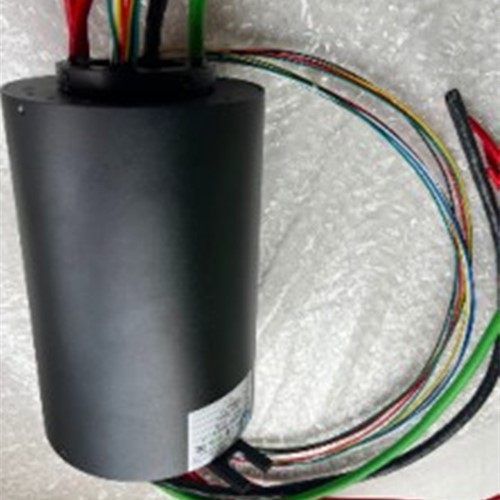
Slip Ring for Armored Vehicles
Armored vehicles are various tracked or wheeled vehicles with armor protection. They are most commonly used in military, civilian and personal security applications and can resist attacks from bullets, shrapnel and projectiles.
The vehicles can travel faster and farther than tracked military vehicles. However, due to the higher ground pressure, they have poor obstacle crossing ability and are more vulnerable to enemy fire. Therefore, they need higher characteristic signal transmission capabilities to help the military detect, command, control the surrounding situation, and communicate with teammates.
Through hole slip rings for armored vehicle assist the operation of on-board radar, monitoring, etc. during the driving process of armored vehicles. This includes the continuous transmission of data and energy during the dynamic process, as well as assisting them in adjusting angles and directions.
Benefits of Slip Rings for Armored Vehicles
Enhance Combat Efficiency
In the armored vehicle turret system, the gunner needs to adjust the turret angle and control the weapon to shoot. The slip ring assists the thermal imaging reconnaissance equipment to rotate at multiple angles to search for targets in all directions. Their rotation range is 30° to 60° per second, and the current transmission error rate is controlled within 1%. In addition, they can transmit several gigabytes of data per second and transmit high-definition thermal imaging data back to the intelligent processing system in the vehicle so that the gunner can understand the environment in time.
Simplify Equipment Structure
In order to reach the combat site faster on the battlefield, armored vehicles often have strict requirements on their own weight and volume. Through hole slip rings for armored vehicles use MEMS (micro-electromechanical systems) technology, with the diameter of only a few centimeters. They can be quickly integrated into the armored vehicles of various weights without adding excessive load.
High-Speed Data Transmission
Armored vehicles are equipped with advanced sensors and intelligent systems, and the requirements for data transmission speed are getting higher and higher. A large amount of data needs to be quickly transmitted from various sensors (such as high-definition 1920×1080 pixel pictures and videos, centimeter-level precision laser rangefinders) to the on-board computer for analysis and processing. In this case, fiber optic slip rings are most commonly used. They can transmit data at a rate of tens of gigabits per second, helping artificial intelligence systems automatically identify target types, assess threat levels, etc.
Improve Compatibility
Slip rings can be integrated with interfaces that comply with NATO standard communication protocols (such as STANAG 4586, etc.) or other international general military communication protocols. When different models of armored vehicles need to share information and communicate during joint operations, these slip rings transmit data in a unified standard format to help exchange battlefield intelligence and command instructions. Alternatively, slip rings can also be designed with a modular structure and combined with other common modules for deployment between different armored vehicles.


Requirements for Slip Rings in Armored Vehicles
Stability
Through hole slip rings for armored vehicle need to withstand continuous vibrations with a frequency range of 10Hz - 500Hz and an amplitude of not less than 5mm when armored vehicles are driving on complex terrain. The internal structure should be tightly connected to maintain stable data and power transmission, with a bit error rate of less than one part per million.
Data Transmission
During use, armored vehicles need to complete information interaction of various advanced electronic devices, such as the transmission of high-definition video surveillance images. This requires slip rings to support multiple communication protocols, such as CAN bus protocol, and a transmission rate of 1 megabit per second.
Protection Performance
When armored vehicles are driving in heavy rain or passing through sandstorm areas, the slip ring is susceptible to wear from grit, dust, and mud. It must have an IP67 or higher protection level to prevent rain and dust from entering the slip ring. In addition, a high-strength aluminum alloy or stainless steel housing can also help the slip ring resist corrosion from seawater and acid rain.
Anti-Interference Ability
If you want to transmit clear signals in real time, the slip rings should have electromagnetic shielding performance and maintain the shielding efficiency above 60dB. Alternatively, they can use differential signal transmission and signal filtering processing technology to suppress common mode interference and high-frequency noise interference, especially within 10 meters of the communication station.