

Can Slip Ring Commutator Handle Current?
Yes, slip ring commutators can handle current ranging from milliamperes for signal transmission to over 7,500 amperes for high-power applications. Standard slip rings handle currents from a few mA to over 100A, with gold brushes allowing up to 500A per ring, while specialized large current slip rings support up to 7,500A with low contact resistance during 360° rotation. The actual current capacity depends on brush material, ring size, contact pressure, and thermal management design.
Understanding Slip Ring Commutator Current Capacity
What Determines Current Handling in Slip Ring Commutators
The current-carrying capacity of a slip ring commutator isn't a single fixed number-it's determined by multiple interdependent factors that electrical engineers must carefully balance.
Brush Material and Contact Design
Brush material selection significantly impacts current capacity, with parameters including current rating, rpm, and operating temperature dictating the most suitable choice. Carbon-graphite brushes typically handle moderate currents up to 50A per circuit, while metal fiber brushes offer high durability and can handle higher current densities per unit area.
Monofilament wire brushes made of precious metals like silver, gold, or palladium are common in low-current slip rings needing clean signal transmission and minimal contact resistance, while polyfilament brushes with multiple contacts per channel exhibit minimal contact resistance and noise for transmitting sensitive analog signals.
Contact Resistance and Electrical Efficiency
Contact resistance directly affects how much current a slip ring can safely handle. Contact resistance increases with rising salt spray concentration and sliding speed, while it decreases with higher contact pressure and increased contact current. Lower contact resistance means less heat generation during operation, allowing higher current transmission.
Contact resistance can be measured as the direct current between the resistance of the terminal and the consistent conductive ring, with brush contact resistance representing the ultimate strength of the brush connection.
Physical Size and Ring Geometry
The limiting factor for current ratings in smaller slip rings is the size of wire and/or bus bar that can fit inside the core of the slip ring. Larger diameter rings provide more surface area for heat dissipation and accommodate thicker conductors, enabling higher current transmission.
Slip Ring vs Commutator: Current Handling Differences
While the terms are sometimes used interchangeably, slip rings and commutators have distinct designs that affect their current-handling characteristics.
Structural Differences
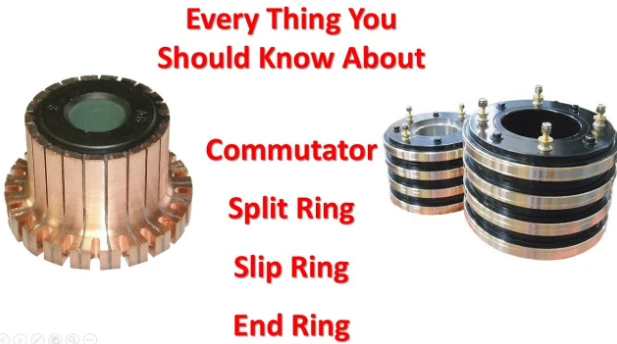
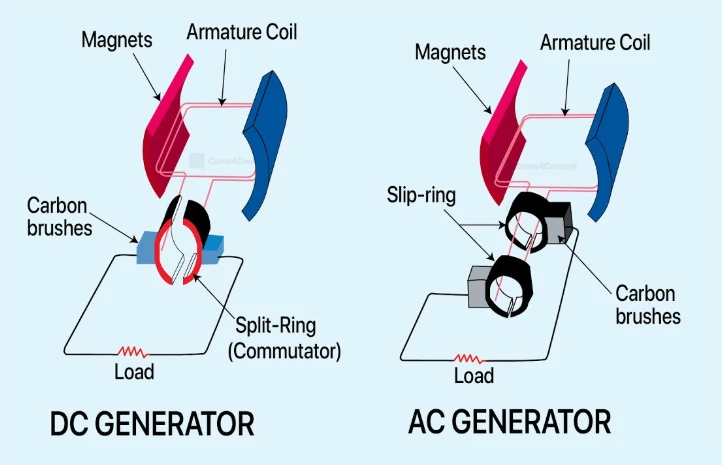
Slip rings typically consist of one or more metal rings connected to the rotor with stationary brushes contacting the rings, maintaining continuous electrical connection as the rotor spins. In contrast, commutators feature a cylindrical arrangement of multiple insulated copper segments that connect to winding coils in the rotor, with stationary brushes remaining in contact with commutator segments to selectively reverse current direction.
Current Transmission Characteristics
A commutator is a specialized slip ring typically used on DC motors and electrical generators to transfer electrical power between the stationary housing and the rotating armature with the added purpose of reversing the electrical current direction. This switching function introduces additional electrical stress and arcing, potentially limiting continuous current capacity compared to slip rings.
Slip rings experience much less arcing than commutators because the current isn't constantly switching, and slip rings are made of one piece with no slots, allowing brushes to travel smoother along the surface with less friction.
Current Rating Specifications for Slip Ring Commutators
Standard Current Ranges
Slip ring commutators are manufactured across a wide spectrum of current ratings to serve different applications.
Low Current Applications (Under 10A)
Basic slip rings are available in various configurations including 3 wires, 4 wires, and different current ratings of 5A, 10A, 15A, and 30A. These lower-rated units suit robotics, CCTV systems, and light industrial equipment where signal quality matters more than raw power transmission.
Medium Current Applications (10A-100A)
Standard slip rings are designed for typical maximum ratings of 600 amps and 600 volts, though this depends on the size of the slip ring driven by application and customer needs. Medium-range slip rings balance cost, size, and performance for general industrial machinery.
High Current Applications (100A-3000A+)
Large current slip rings are specialized devices working with high currents from 50A to 2,500A for power transmitting and signal transmitting. Some manufacturers have built rings with capacities of 1,000 amps, 2,000 amps, 3,000 amps and more, using modular brush holders bussed together to achieve high current carrying capacity.
For extreme applications, MW series large current slip rings can support maximum currents up to 7,500A with low contact resistance during 360° rotation, featuring aluminum alloy or antiflaming engineering plastic housings designed for fast heat emission with numerous cooling holes.
Voltage and Current Relationships
Current capacity can't be considered in isolation from voltage requirements.
PCB slip rings are rated up to 1,000V AC/DC for standard designs with current handling from a few mA to over 100A, while high-speed rings support rotational speeds above 5,000 rpm. Manufacturers regularly build slip rings rated well beyond 600 volts, and can go higher given adequate space, though higher voltage and amperage ratings require increased spacing and larger conductor sizes, resulting in very large slip ring assemblies.
Voltage Drop Considerations
Transmission of power requires consideration of the voltage drop across the slip ring and actual current flow, as this variation depends on brush contact mode and force, rpm, and temperature. Excessive voltage drop indicates high contact resistance, limiting effective current transmission and generating unwanted heat.

Factors Limiting Slip Ring Commutator Current Capacity
Thermal Management Challenges
Heat generation represents the primary constraint on current capacity in slip ring commutators.
Heat Generation Sources
Current flowing through contact resistance generates I²R heating at the brush-ring interface. The resulting temperature fluctuations from Joule heat directly impact service life of the carbon brush and slip ring system. Higher currents exponentially increase heat generation, making thermal management critical.
Cooling Requirements
Large current slip rings are tested for high current shock and temperature rise before delivery, with housings designed with large numbers of cooling holes for fast heat emission. Forced air cooling, liquid cooling, or conductive heat sinks may be necessary for sustained high-current operation.
Mechanical Wear and Brush Life
Contact Pressure and Wear Rate
Although typically one brush pair per ring, amperage requirements may necessitate using four or even more pairs per circuit to distribute current and reduce wear. Excessive brush wear can be addressed by using appropriately hard brushes, smoothing the slip ring surface, or replacing worn components.
Arcing and Electrical Erosion
High currents increase the likelihood of arcing, particularly during momentary contact interruptions. Brush noise and arcing typically happens with high electrical load, usage of wrong brush type or size, or rapid changes in operational parameters. Arc damage accelerates both brush and ring surface degradation.
Speed Limitations
Rotational speed affects current capacity through multiple mechanisms. At high RPMs, the commutator copper slot surface speed becomes problematic, causing accelerated wear, while at low RPM the wear remains minimal. Standard slip rings allow rotational speeds up to 1,000 rpm, while high-speed rings support above 5,000 rpm, though higher speeds typically require derating of current capacity.
Optimizing Slip Ring Commutator Current Performance
Material Selection Strategies
Ring Material Options
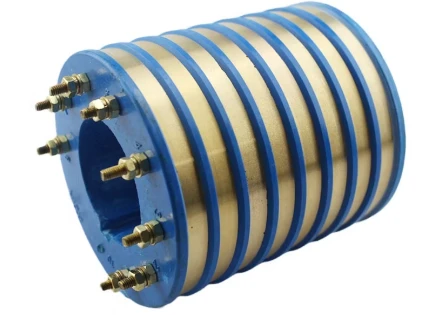
Rings are made of electrically conductive metal, usually brass, but can also be plated silver or coin silver, and are mounted on but insulated from a center shaft using nylon, phenolic plastic or other non-conductive material. Silver plating reduces contact resistance, enabling higher current transmission with less heat generation.
Advanced Brush Technologies
Future developments may leverage carbon nanotubes or graphene-infused compounds offering superior conductivity, durability, and resistance to wear, potentially extending operational life significantly. UEA brush contacts made of sintered metal copper graphite or silver graphite rub against the outside of rotating metal rings, maintaining continuous electrical connection.
Design Considerations for High Current
Parallel Circuit Configuration
Using two slip rings in parallel will double the current capacity or reduce current through each brush/ring, providing redundancy and reliability. This approach distributes heat generation across multiple contact points, substantially improving current handling.
Contact Configuration
Multiple contacts for each channel, as in polyfilament brushes, reduce resistance variation and improve reliability for high-current applications. More contact points also provide redundancy if individual contacts fail.
Environmental Factors
The harsh marine environment including salt spray deposition alters the contact surface and significantly affects contact resistance in carbon brush and slip ring systems. Protected enclosures, sealed designs, and corrosion-resistant materials extend service life in challenging environments.
In hotter environments, a slip ring with higher amp data may be required as high temperatures affect the slip ring's capability to carry current efficiently, while systems running continuous or longer duty cycles need slip rings handling higher current loads regularly.
Slip Ring Commutator Applications by Current Range
Low-Power Signal Transmission (Under 5A)
Low-current slip rings needing clean signal transmission use monofilament precious metal wire brushes with minimal contact resistance. These applications include:
Rotating CCTV cameras
Laboratory test equipment
Medical imaging systems
Robotic sensor arrays
Data transmission systems
Medium-Power Industrial (5A-100A)
Standard industrial slip rings handle moderate power for:
Packaging machinery
Automated production lines
Cable reels and spooling systems
Radar antennas
Theater lighting systems
High-Power Heavy Industry (100A-1000A+)
High current slip rings can handle currents up to 20 amps for various applications, with high power slip rings available capable of transferring currents up to 1,000A while ensuring safety and efficiency. Applications include:
Wind turbine generators
Marine propulsion systems
Heavy construction equipment
Ship cranes and deck machinery
Industrial furnace rotary mechanisms
Maintenance and Troubleshooting Current-Related Issues
Common Current-Related Problems
Overheating
Overheating is often the consequence of high rotational speeds, excessive current, or utilization of incorrect brush material. Solutions include selecting appropriate brush materials, restricting speed and load within permissible limits, and increasing cooling measures through forced air or water cooling.
Poor Contact Performance
Poor contact with the ring typically results from insufficient spring pressure, incorrect brush grade, or improperly seated brush, which can be addressed by improving contact level through increased spring pressure, reseating the brush properly, or utilizing the correct brush grade.
Excessive Dust Accumulation
Certain brushes like carbon types produce dust that can accumulate and disrupt efficient system functioning, requiring periodic inspection and cleaning of slip rings and brushes, or using brushes producing less dust.
Monitoring and Predictive Maintenance
Future slip rings and brushes could incorporate sensors and IoT connectivity to monitor wear and performance in real-time, allowing for predictive maintenance and minimizing downtime. Current monitoring systems can detect degradation before catastrophic failure occurs.
Selecting the Right Slip Ring Commutator Current Rating
Calculating Total Current Requirements
The first step in choosing appropriate slip ring amp data is accurately calculating the total current requirement of your system, where every device or module linked to the slip ring draws specific current amounts that must be totaled. Underestimation leads to overloading, often resulting in device failure or degradation.
Safety Margin Considerations
It's essential to accommodate a safety factor above the estimated load, also known as the safety margin, since electrical systems might experience sudden or unforeseen spikes in current due to various factors. Typical safety margins range from 20-50% above calculated maximum current.
Operating Environment Assessment
Operating environment and duty cycle influence the demand for amp data, with systems running continuous or longer duty cycles needing slip rings that can handle higher current loads regularly. Intermittent operation allows higher peak currents than continuous duty applications.
Longevity and Derating
Selecting a slip ring with higher amp rating is advisable to ensure prolonged device life, as operating the slip ring below maximum capacity reduces wear and tear, preserving rotating contacts and extending lifespan while reducing maintenance frequency.
Frequently Asked Questions
Can slip rings handle DC and AC current equally well?
Slip rings handle both DC and AC current, though design considerations differ. Slip rings maintain continuous electrical connection between stationary and rotating components for uninterrupted transmission of electrical signals and power in machines with rotating parts, while AC current naturally reduces some arcing issues compared to DC applications. DC applications may require special brush materials to minimize wear from sustained unidirectional current flow.
What's the maximum current a slip ring can theoretically handle?
Large current slip ring designs can support maximum currents up to 7,500A with specialized cooling and contact systems. Theoretical limits depend on physical size constraints, cooling capability, and material properties. Practical industrial applications rarely exceed 3,000A per circuit due to size, cost, and reliability considerations.
How does current capacity degrade over slip ring lifetime?
Current capacity decreases as brush and ring surfaces wear, increasing contact resistance. Brush lifetime reaches around 25 million rotations for split rings, while slip rings with precious metal contacts achieve over 100 million rotations. Regular maintenance, proper lubrication, and brush replacement maintain rated current capacity throughout service life.
Why can't commutators handle as much current as slip rings?
Commutators experience much more arcing than slip rings because current constantly switches as brushes disconnect from one polarity and reconnect to another polarity repeatedly. This switching action generates electrical stress and heat, limiting sustained current capacity compared to slip rings' continuous contact.
Data Sources:
Wikipedia - Slip Ring (May 21, 2025)
Moflon Technology - How A Slip Ring Works
Mercotac - Brushless Slip Ring
Grand Slip Ring - Slip Ring and Commutator Difference (February 23, 2025)
RayPCB - PCB Slip Ring vs Split Ring (November 7, 2023)
United Equipment Accessories - Slip Ring Circuit Ratings
Motion Control Tips - Electric Slip Rings (October 17, 2022)
Grand Slip Ring - Slip Ring Amp Data (September 27, 2023)
MDPI Sensors - Contact Resistance for Brush and Slip Ring System (September 23, 2025)
Grand Slip Ring - Slip Ring Brushes (February 26, 2025)