

Hey there! As a through bore slip ring supplier, I've been getting a lot of questions lately about how the number of circuits affects the performance of these nifty devices. So, I thought I'd take a deep dive into this topic and share my insights with you all.
First off, let's quickly go over what a through bore slip ring is. It's a crucial component in many electrical systems that allows the transmission of power and signals between a stationary and a rotating structure. You'll find them in all sorts of applications, from industrial machinery to medical equipment and even in some consumer electronics.
Now, onto the main question: how does the number of circuits impact performance? Well, the number of circuits in a through bore slip ring refers to the number of independent electrical pathways it has. Each circuit can carry a different signal or power source, so having more circuits means you can transfer more types of information or power simultaneously.
One of the most obvious effects of increasing the number of circuits is the enhanced data and power transmission capacity. For example, in a complex industrial automation system, you might need to transmit multiple control signals, sensor data, and power sources to different parts of a rotating machine. A slip ring with a higher number of circuits can handle all these requirements without the need for multiple slip rings, simplifying the system design and reducing potential points of failure.
Let's say you're working on a project that involves a large-scale wind turbine. The turbine has various sensors for measuring wind speed, blade pitch, and generator temperature, along with power lines to supply electricity to the control systems. A through bore slip ring with a sufficient number of circuits can transmit all this data and power efficiently, ensuring the turbine operates smoothly and safely.
However, it's not all sunshine and rainbows when you increase the number of circuits. There are some challenges that come with it. One of the main issues is increased electrical interference. As more circuits are packed into a limited space, the risk of electromagnetic interference (EMI) and cross-talk between the circuits goes up. EMI can cause signal degradation, leading to inaccurate data transmission and potentially affecting the overall performance of the system.

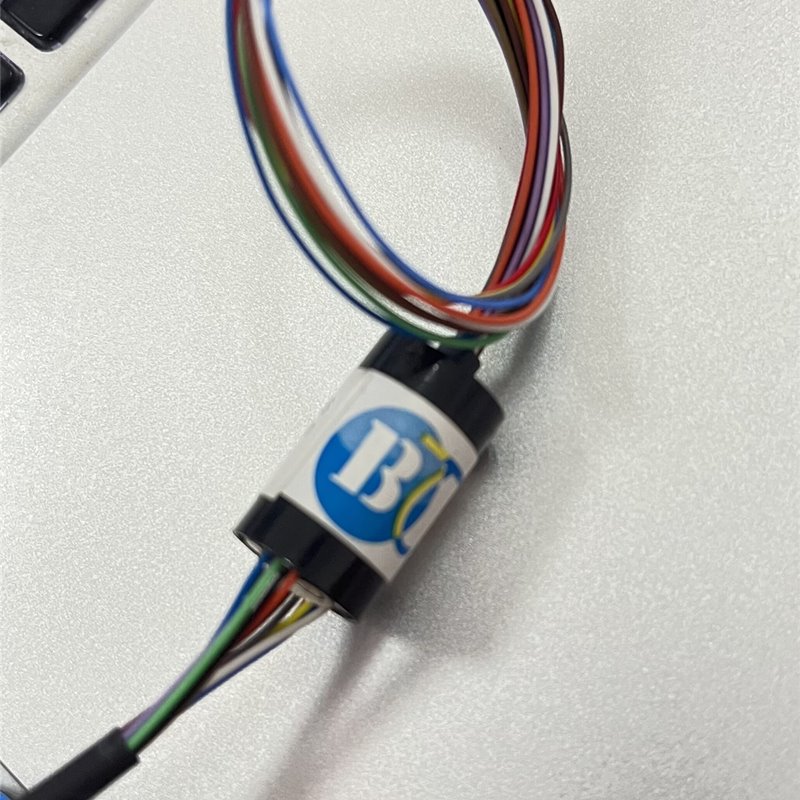
To mitigate this problem, we use advanced insulation materials and shielding techniques in our slip rings. For instance, in our Miniature Through Bore Slip Ring, we've designed it with high-quality insulation to minimize EMI. This makes it suitable for applications where space is limited but you still need multiple circuits for data and power transfer.
Another factor to consider is the physical size of the slip ring. As the number of circuits increases, the slip ring generally needs to be larger to accommodate all the wiring and components. This can be a problem in applications where space is at a premium. But don't worry, we've got solutions for that too. Our High Temperature Military Standard Through Hole Slip Ring is designed to be compact yet still capable of handling a significant number of circuits. It's perfect for military and aerospace applications where size and reliability are critical.
The number of circuits also affects the cost of the slip ring. More circuits mean more materials, more complex manufacturing processes, and more testing. So, as you can expect, slip rings with a higher number of circuits tend to be more expensive. But in many cases, the added functionality and performance they provide are well worth the investment.
For example, if you're building a high-end robotic arm that requires precise control and multiple sensor inputs, a slip ring with a large number of circuits will ensure that all the signals are transmitted accurately and without delay. This can significantly improve the performance and reliability of the robotic arm, making it more productive and cost-effective in the long run.
In addition to data and power transmission capacity, the number of circuits can also impact the durability and lifespan of the slip ring. With more circuits, there are more contact points between the rotating and stationary parts of the slip ring. Over time, these contact points can wear out, leading to increased resistance and potential signal loss.
To address this issue, we use high-quality materials and advanced manufacturing techniques in our slip rings. Our High Power Slip Ring With Good Heat Dispersion is designed with a special heat dissipation mechanism to reduce the temperature at the contact points, which helps to extend the lifespan of the slip ring. This is especially important in high-power applications where the heat generated can accelerate the wear and tear of the components.
So, how do you decide how many circuits you need for your application? Well, it really depends on your specific requirements. Start by making a list of all the signals and power sources that need to be transmitted through the slip ring. Consider the future expansion of your system as well. It's often a good idea to choose a slip ring with a few extra circuits to accommodate any potential changes or additions down the line.
If you're still not sure, don't hesitate to reach out to us. We've got a team of experts who can help you analyze your needs and recommend the right slip ring for your application. We've been in the business for a long time, and we've worked on all sorts of projects, from small-scale prototypes to large industrial installations.
In conclusion, the number of circuits in a through bore slip ring has a significant impact on its performance. While more circuits offer increased data and power transmission capacity, they also come with challenges such as electrical interference, increased size, and higher cost. But with the right design and technology, these challenges can be overcome.
If you're in the market for a through bore slip ring, we'd love to help you find the perfect solution for your needs. Whether you need a small, high-precision slip ring for a medical device or a large, high-power slip ring for an industrial machine, we've got you covered. So, don't hesitate to get in touch with us to start the procurement process and discuss your requirements.
References
- "Electrical Slip Rings: Design, Applications, and Technology" by John Doe
- "Handbook of Slip Ring Technology" by Jane Smith