


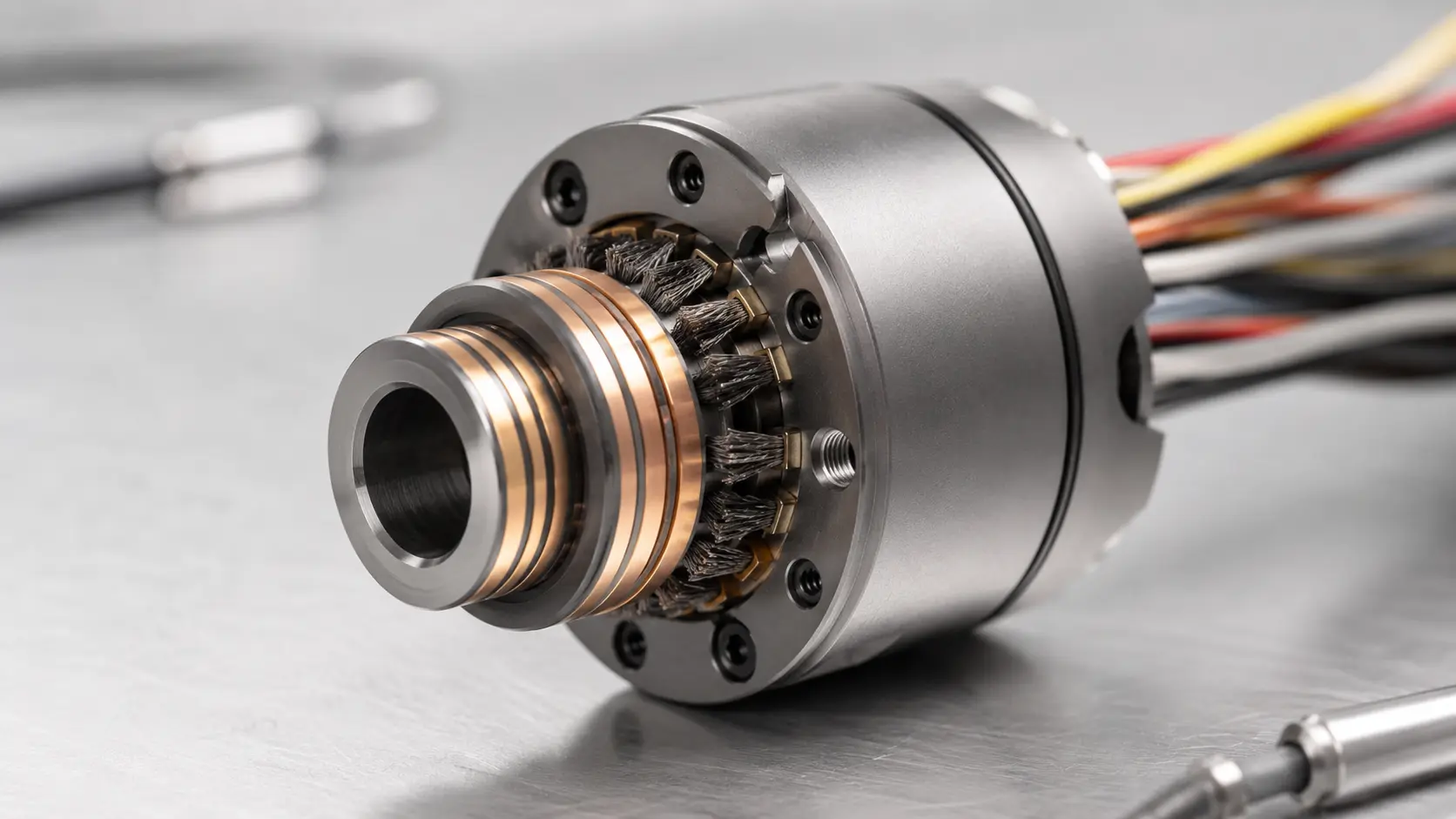
Wire brush slip rings transfer power, signals, and in many cases data across a continuously rotating interface. They are chosen when a rotating system needs stable contact in a compact package, without the carbon dust generated by traditional carbon brush designs. They are not, however, a default upgrade. For heavy-duty current transfer, abrasive environments, or specialized RF lines, another contact design will often be more appropriate.
This guide is written from a slip ring application engineering perspective. It explains how wire brush contact works, where it earns its place, how it compares with carbon brush slip rings on the dimensions buyers actually weigh, and what information your supplier needs before quoting. A worked example with realistic parameters is included at the end, along with a FAQ for the questions that come up most often during selection.
What Is a Wire Brush Slip Ring?
A wire brush slip ring is an electromechanical assembly that maintains an electrical connection between a stationary structure and a rotating component. The function is shared by every electrical slip ring; the difference lies in the contact.
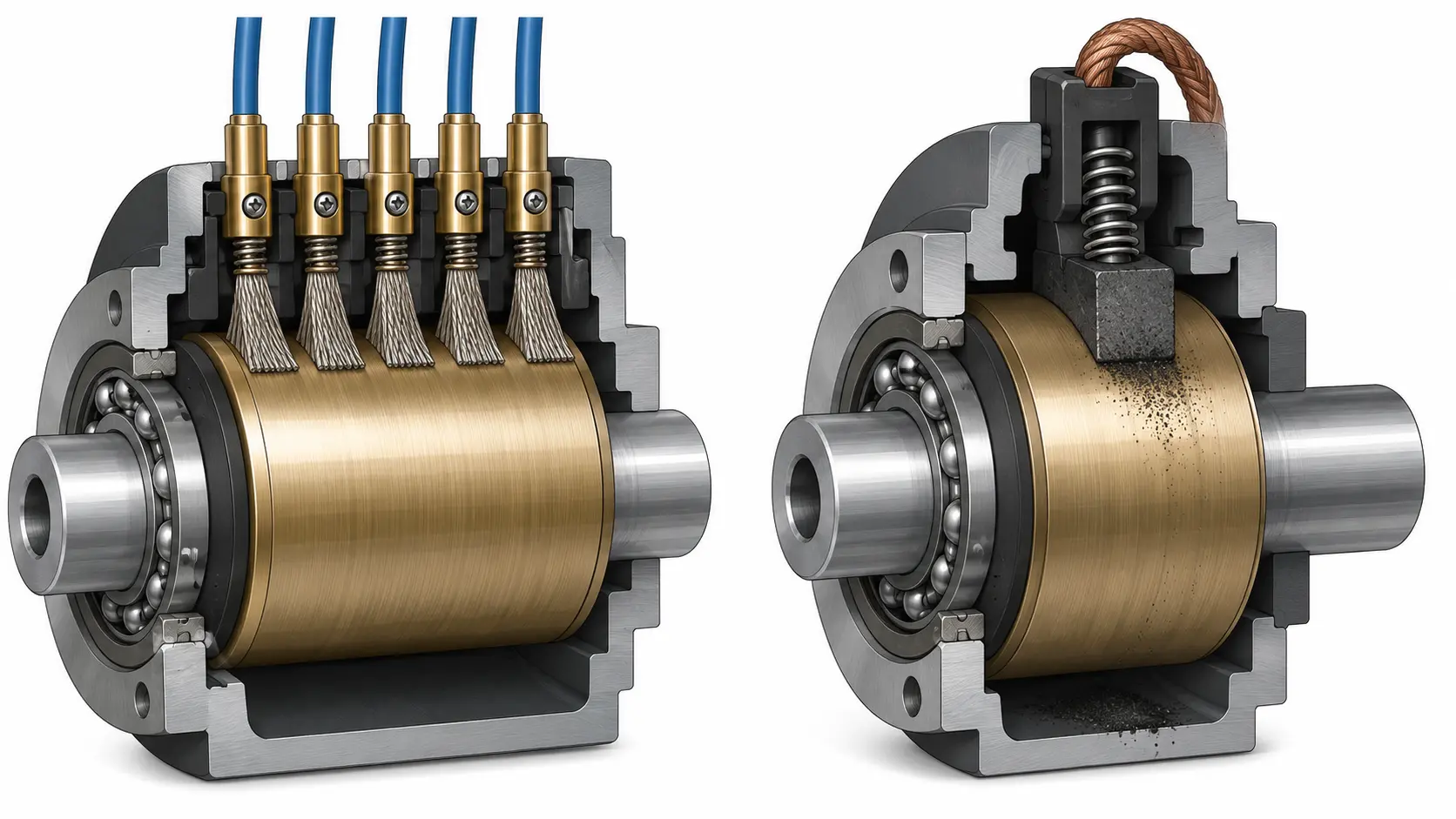
Instead of a single carbon block pressed against each conductive ring, a wire brush design uses a bundle of fine, springy conductive wires. Each wire is its own contact point, and several wires ride on the same ring simultaneously. This multi-point contact is the source of most of the design's electrical and mechanical behavior: lower contact resistance variation, lower electrical noise on signal lines, and a wear profile that does not shed conductive carbon dust into the surrounding mechanism.
Wire brush contact is sometimes called fiber brush or multi-fiber brush contact in technical literature, especially when very fine precious-metal alloy wires are used for low-level signal circuits.
How Wire Brush Contact Actually Works
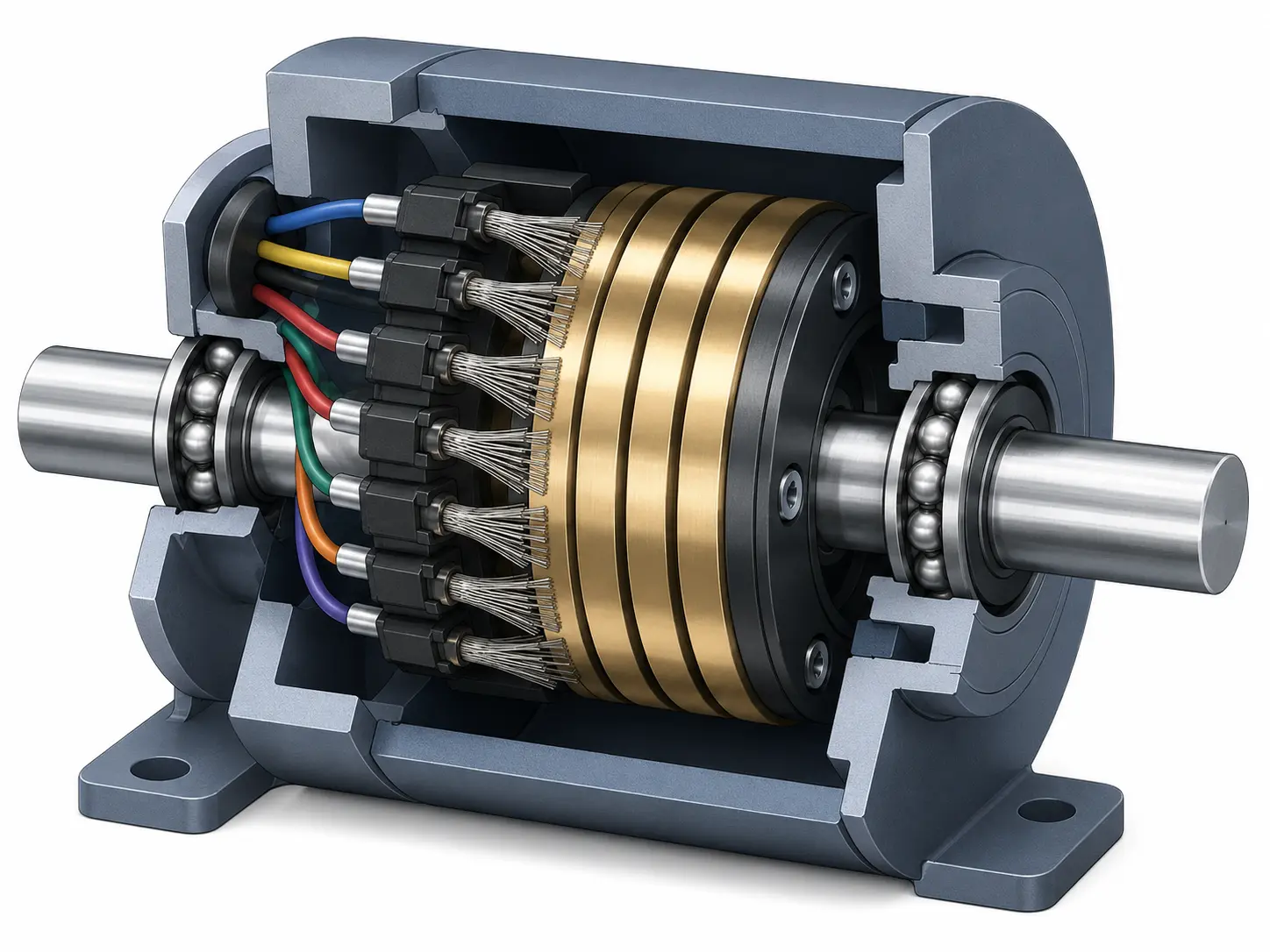
A slip ring has a stationary housing (the stator) and a rotating shaft or sleeve (the rotor). Conductive rings sit on the rotating side. Brush blocks sit on the stationary side, each holding the wire bundle that presses against one ring. As the rotor turns, current or signal passes through brush wires, into the ring, and out the rotor leads to whatever is mounted on the rotating equipment.
Three details matter more than most catalogs admit:
- Number of effective contacts. A single carbon block may have one main contact patch. A wire bundle may have ten to several dozen independent micro-contacts on the same ring. If a few are momentarily lifted by vibration or contamination, others are still conducting. This is what makes wire brush contact attractive for sensors, encoders, and low-voltage digital lines.
- Contact pressure per wire. Each wire is light. Total normal force is low compared with a carbon brush, which reduces friction torque and heat at the contact surface. The trade-off is that any single wire cannot pass a heavy current; high-current circuits are handled by parallel rings or wider brush groups.
- Material pairing. Brush wires are commonly precious-metal alloys (silver- or gold-based) for signal circuits, while ring surfaces use complementary platings. The pairing controls contact resistance stability over the service life, and it is the single biggest factor in whether a slip ring still meets spec after a million revolutions.
Wire brush contact still wears. The trade is not "no wear" versus "carbon wear" - it is fine metallic wear that stays inside the housing versus carbon particulate that can escape into surrounding mechanisms.
Where Wire Brush Slip Rings Earn Their Place
Wire brush designs are typically specified when at least one of the following is true:
- The system carries low-voltage signals, encoder feedback, or data lines that cannot tolerate the noise floor of a worn carbon brush.
- The surrounding environment is sensitive to particulate (optical systems, medical imaging, semiconductor handling, cleanrooms).
- Vertical or radial space is tight and a short stack height matters more than maximum current capacity.
- Maintenance access is poor - the unit must run for tens of thousands of hours before any service intervention.
- Power circuits and signal circuits must share a single compact housing.
The design is a poor fit when the dominant requirement is hundreds of amps per circuit, when the environment is heavily abrasive or chemically corrosive, or when a specialized solution such as a fiber optic slip ring or RF rotary joint is required for the data link.
Wire Brush vs Carbon Brush Slip Rings
Both contact styles work. The question is which one fits the application's electrical, mechanical, and service constraints. A traditional carbon brush slip ring remains the right answer in many heavy-duty rotating power applications; wire brush wins on different terrain.
| Dimension | Wire Brush Slip Ring | Carbon Brush Slip Ring |
|---|---|---|
| Typical current per circuit | Generally suited to low- and medium-current circuits; high current is handled by paralleling rings | Comfortable at high single-circuit currents in heavy-duty designs |
| Electrical noise on signal lines | Lower noise floor, well-suited to encoder, analog sensor, and digital data lines | Higher contact noise as brushes wear; usually filtered or used for power only |
| Particulate generation | Fine metallic wear retained inside the housing | Carbon dust released during operation; requires containment in clean environments |
| Maintenance interval | Long; brush replacement is infrequent in normal-duty applications | Periodic brush inspection and replacement is part of the service plan |
| Friction torque | Low; light per-wire contact pressure | Higher; spring-loaded carbon blocks |
| Compactness | Strong; supports short stack heights and small bore diameters | Larger envelope, especially for high-current designs |
| Tolerance to vibration | Multi-point contact rides through brief disturbances | Single contact patch is more sensitive to chatter |
| Cost at high current | Rises quickly because more rings must be paralleled | Cost-effective in heavy-duty power-only applications |
| Best fit | Mixed power and signal, compact assemblies, signal-sensitive systems, low-maintenance installations | High-current power transfer, traditional industrial drives, generator excitation, heavy-duty rotating equipment |
Engineering note: when an application combines a small amount of high-current power with many low-voltage signal lines, the practical decision is usually wire brush - and the rare high-current circuit is handled by paralleling rings, not by switching contact technology.
Common Applications, with the Electrical Detail That Matters
Generic application categories are easy to list. What follows is more useful: the typical mix of circuits each device needs, and what tends to drive the specification.
Industrial Automation: Indexing Tables, Rotary Fillers, Labeling Turrets
A rotary indexing table or a labeling turret in a packaging line typically needs 24 V DC control power, a handful of digital I/O lines, one or two encoder channels, and sometimes a fieldbus connection. Wire brush contact suits the signal side; the duty cycle is high (multiple shifts per day) and maintenance windows are short. A compact through-hole slip ring with a wire brush contact set is a common configuration because the central bore allows pneumatic or mechanical shafts to pass through.
Surveillance, EO/IR, and Pan-Tilt Camera Platforms
Continuously rotating camera platforms transmit DC power, motor drive lines, control signals, and a video or Ethernet link. Signal integrity dominates the specification: any contact noise shows up as image artifacts or packet loss. The decision is rarely "what type of brush" - it is "what shielding strategy and channel separation are required."
Robotics, ROV, UAV Gimbals, and Rotating End Effectors
Compact, low-torque designs matter most here. A robotic wrist that carries an EOAT cannot afford a heavy slip ring. Wire brush contact's low friction torque and small envelope are the deciding factors, alongside a mix of USB or Ethernet signal channels for the payload.
Test and Measurement Fixtures
Rotating test fixtures, instrumented dynamometers, and automotive component test rigs carry low-level analog signals, thermocouple inputs, and sometimes high-speed digital lines. Contact noise is the enemy. Material pairing and shielding within the slip ring are more important than the brush form factor itself.
Surveillance Radars, Antennas, and Rotating Communications Platforms
Antenna positioners often combine power and signal in a single rotating joint, sometimes alongside a dedicated RF rotary joint for the high-frequency path. Wire brush contact handles the lower-frequency signals and DC power cleanly.
How to Specify a Wire Brush Slip Ring
The fastest way to a correct quote is to define the application across six dimensions before contacting a manufacturer. Skipping any one of them is the most common cause of a redesign after the first prototype.
1. List Every Circuit Separately
Do not give a supplier a single number like "10 circuits." Itemize:
- Function of the circuit (motor power, control, encoder A/B/Z, Ethernet pair, video, etc.)
- Continuous current rating and peak/inrush current - the inrush figure is what determines contact sizing on motor and solenoid lines
- Voltage, AC or DC, and required isolation
- Whether the line is shielded, and whether the shield must rotate with the cable or terminate at the housing
If continuous and peak currents are confused, the resulting design will either run hot or be over-specified at a higher cost than necessary.
2. Define Signal and Data Types Precisely
"It needs to carry signals" is not a specification. Identify the protocol, speed, and electrical standard for each line. Common cases include analog 0–10 V or 4–20 mA sensor outputs, RS-485 or CAN bus, Profinet, EtherCAT, 100Base-TX, 1000Base-T, video (HD-SDI, analog composite, GigE Vision), or RF.
Ethernet in particular is not a single specification. A slip ring designed for 100 Mbps Fast Ethernet will not necessarily pass Gigabit Ethernet on a rotating contact path without internal impedance control, controlled crosstalk between pairs, and adequate shielding. The transmission requirements are defined in the IEEE 802.3 standard, and a slip ring that has not been characterized against those requirements cannot be assumed to support the link.
Engineering note: route Ethernet pairs away from motor and solenoid circuits whenever the channel layout allows. Where mixing is unavoidable, shielding strategy becomes the critical design choice - see this practical overview of shielding solutions for slip ring signal transmission.
3. Confirm Speed and Duty Cycle
Slip rings are typically rated for a continuous RPM, but the duty cycle determines life. A machine that rotates at 20 RPM continuously, 24/7, accumulates more revolutions in a year than a 300 RPM system that runs an hour a day. Provide:
- Maximum and typical RPM
- Continuous vs intermittent operation
- Direction (uni- or bidirectional)
- Expected total operating hours or total revolutions to end of life
4. Specify the Mechanical Envelope
List every mechanical constraint the slip ring must respect: outer diameter, overall height, required through-bore size if any, mounting interface, cable exit direction and length, connector preferences, and the allowed torque on the rotor. If vertical space is tight, a pancake slip ring with wire brush contact may be a better fit than a stacked cylindrical design.
5. Describe the Environment
Operating temperature range, humidity, dust, washdown, vibration, shock, altitude, and corrosive atmosphere all affect material selection, sealing, and contact pairing. Required ingress protection should be stated as an IP code defined under IEC 60529; for context on what each digit means in practice, see this interpretation of slip ring IP ratings.
6. Decide Between Standard and Custom Early
A standard catalog model is faster to deliver and cheaper. A custom slip ring is justified when the mechanical envelope, circuit mix, or environment cannot be served by a stock part - which is often the case for compact, mixed power-and-signal designs. The trade-off is covered in more depth in this article on standard vs custom slip rings.
Selection Checklist
Before issuing an RFQ, confirm you can answer each item on this list:
- Number of circuits, broken down by function
- For each circuit: continuous current, peak/inrush current, voltage, AC or DC
- Signal protocols and speeds (encoder type, fieldbus, Ethernet speed, video standard, RF frequency)
- Shielding and grounding requirements per circuit
- Maximum RPM, typical RPM, duty cycle, direction
- Target service life in hours or revolutions
- Outer diameter, overall length, through-bore size, mounting style
- Cable exit direction, cable length, connector type
- Operating temperature range
- Required IP rating per IEC 60529, plus any washdown or chemical exposure
- Vibration and shock environment
- Compliance requirements (UL, CE, military, medical, etc.)
Worked Example: Rotating Inspection Platform with Power and Gigabit Ethernet

The parameters below are illustrative - they reflect a configuration we see frequently rather than any single customer project.
- Application: Continuously rotating optical inspection turret, indoor cleanroom-adjacent area
- Rotor payload: Industrial camera, ring light, control board, ambient temperature sensor
- Circuits: 2 × 5 A continuous DC power (24 V), 1 × Gigabit Ethernet (4 twisted pairs), 2 × digital I/O, 1 × thermocouple input
- RPM: 60 RPM continuous, bidirectional
- Duty cycle: 22 hours per day, 6 days per week
- Mechanical envelope: 50 mm available stack height, 25 mm through-bore for a pneumatic line
- Environment: 15–30 °C, low dust, no washdown, IP54 sufficient
- Target service life: 8,000 hours minimum before any service intervention
The configuration that fits is a through-bore wire brush slip ring with the Ethernet pairs routed on dedicated, internally shielded channels separated from the 24 V power rings. The thermocouple line is grouped with the low-level signals on the opposite side of the housing from the power rings. The brush material is a precious-metal alloy on the signal side and a heavier-duty pairing on the two power rings.
What this example illustrates is not that wire brush contact "supports Ethernet" in general - it is that a specific channel layout, shielding plan, and material pairing must be engineered to make the link work over a continuously rotating contact.
Common Specification Mistakes
- Treating circuit count as the only number. Two 12-circuit slip rings can have completely different lives if one is sized for inrush current and the other is not.
- Specifying "Ethernet" without the speed. 100Base-TX and 1000Base-T have different demands on impedance control and crosstalk within the slip ring.
- Underestimating environment. A part that worked in a benchtop prototype can fail in months once installed near a coolant mist or in an outdoor enclosure with daily condensation cycles.
- Assuming a standard model will mount. Cable exit direction, connector type, and torque envelope frequently rule out an apparent catalog match.
- Defaulting to wire brush for high-current power. A heavy-duty single circuit at hundreds of amps is still carbon brush territory in most cases.
FAQ
Q: Are Wire Brush Slip Rings Better Than Carbon Brush Slip Rings?
A: Neither is universally better. Wire brush contact has the advantage on signal cleanliness, compactness, low maintenance, and clean operation. Carbon brush contact has the advantage on heavy single-circuit current and on cost in pure power-transfer applications. The right answer depends on the circuit mix, environment, and service expectations.
Q: Can A Wire Brush Slip Ring Transmit Ethernet?
A: Yes, when the slip ring is designed for it. A general-purpose model cannot be assumed to pass Gigabit Ethernet to standard. The internal channel layout, impedance control, pair separation, and shielding must be engineered against the IEEE 802.3 transmission requirements, and the unit should be tested against those requirements before being deployed on a critical link.
Q: How Long Does A Wire Brush Slip Ring Last?
A: Service life is driven by total revolutions, current per circuit, contact material pairing, environment, and load profile. Typical signal-grade designs are specified for tens of millions of revolutions before contact resistance drifts out of spec; heavily loaded power rings wear faster. Always ask your supplier for a service life figure tied to your actual duty cycle, not a generic "long life" claim.
Q: What Current Can A Wire Brush Slip Ring Handle?
A: Per circuit, wire brush designs are most comfortable in the low- to medium-current range - typically up to a few tens of amps continuous on a single ring of standard size. Higher currents are handled by paralleling rings within the same housing. If your design needs hundreds of amps on one circuit, a carbon brush or specialty contact will usually be more economical.
Q: Are Wire Brush Slip Rings Maintenance-Free?
A: Effectively maintenance-free is closer to the truth than literally maintenance-free. The contact wears, just slowly and without releasing carbon dust. Most installations require no scheduled service for thousands of hours, but inspection at the recommended service interval is still part of a responsible reliability plan.
Q: What Is The Difference Between A Wire Brush Slip Ring And A Fiber Brush Slip Ring?
A: The terms are often used interchangeably. "Fiber brush" usually emphasizes very fine multi-strand contact bundles, often of precious-metal alloy, used for signal-grade circuits. "Wire brush" is the broader term and includes both signal-grade and heavier-duty implementations.
Q: When Should I Choose A Carbon Brush Slip Ring Instead?
A: Choose carbon brush when the application is dominated by high single-circuit current, when the environment is heavy-duty industrial and carbon dust is acceptable, when budget pressure on a power-only design is strong, or when the rotating equipment is already specified with carbon brush maintenance as part of its service plan.
Q: Do I Need A Standard Or A Custom Wire Brush Slip Ring?
A: If your circuit mix, mechanical envelope, and environment fit a catalog item, the standard part is faster and cheaper. If any one of those constraints is unusual - a tight stack height, a mixed power-and-Ethernet circuit list, a specific connector and cable exit - a custom design will deliver a better result. A simple way to decide is to fill out the selection checklist above and see whether any line item falls outside the standard catalog.