


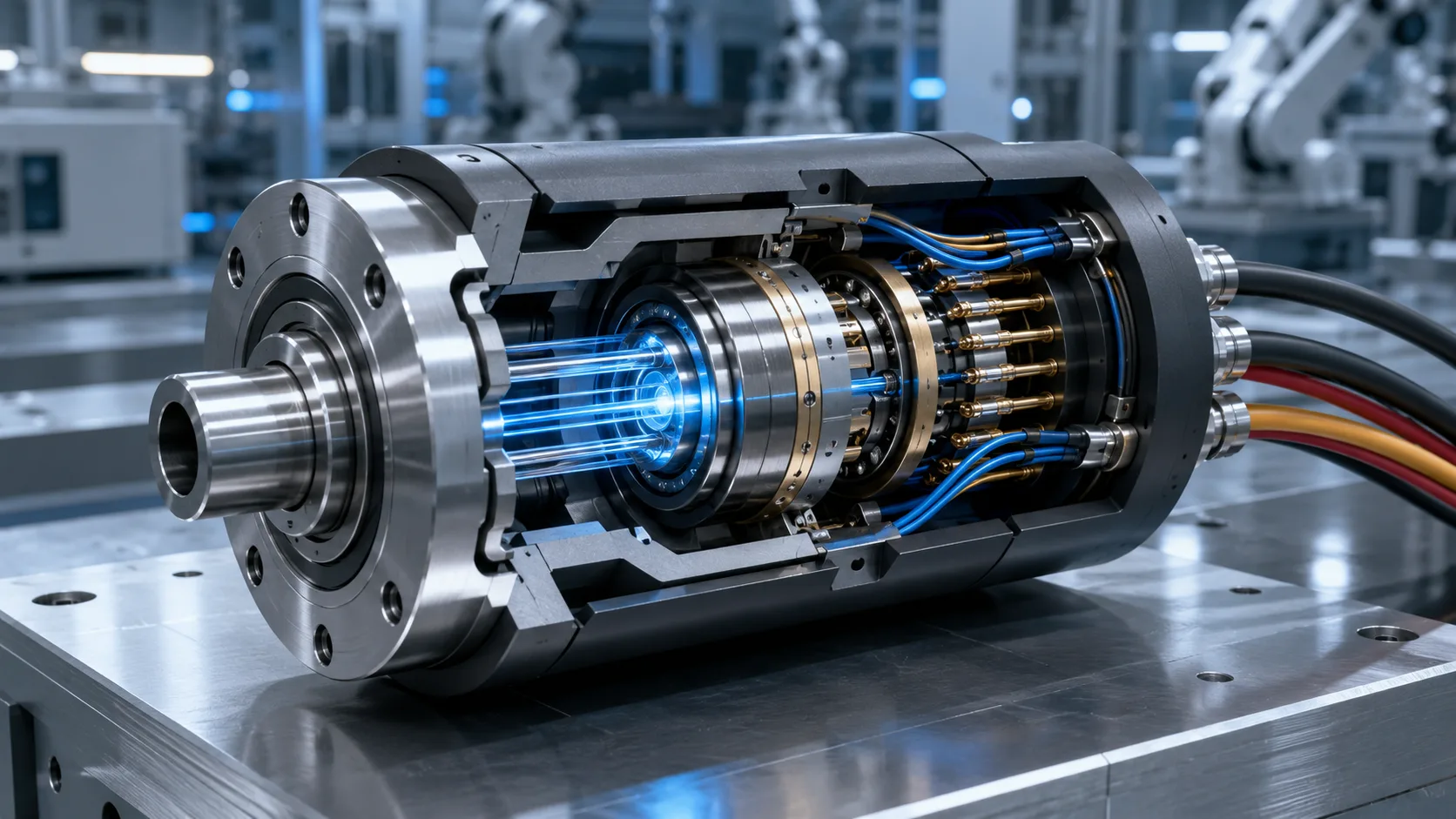
In continuously rotating systems, ordinary fiber cables twist, fatigue and eventually fail. In the projects we have supported as a slip ring manufacturer, this is rarely a connector problem. It is usually a system-level problem: the optical path was treated as an afterthought next to the power and control lines, and only revealed itself once the machine was rotating at speed in the field.
A fiber optic rotary joint, also called a FORJ or fiber optic slip ring, solves this by allowing optical signals to cross a rotating interface without twisting the fiber. In most modern machines, the FORJ is not bought as a standalone part. It is integrated with an electrical slip ring into a single hybrid assembly that carries power, low-voltage signals, Ethernet, fieldbus and optical data through one rotary axis.
This guide is written from the perspective of an application engineering team that specifies and tests these assemblies for industrial, marine, defense and medical customers. It covers what a FORJ is, how it works, when a hybrid solution is the right choice, the specifications that actually matter, and the information you need to prepare before contacting a supplier.
What Is a Fiber Optic Rotary Joint?
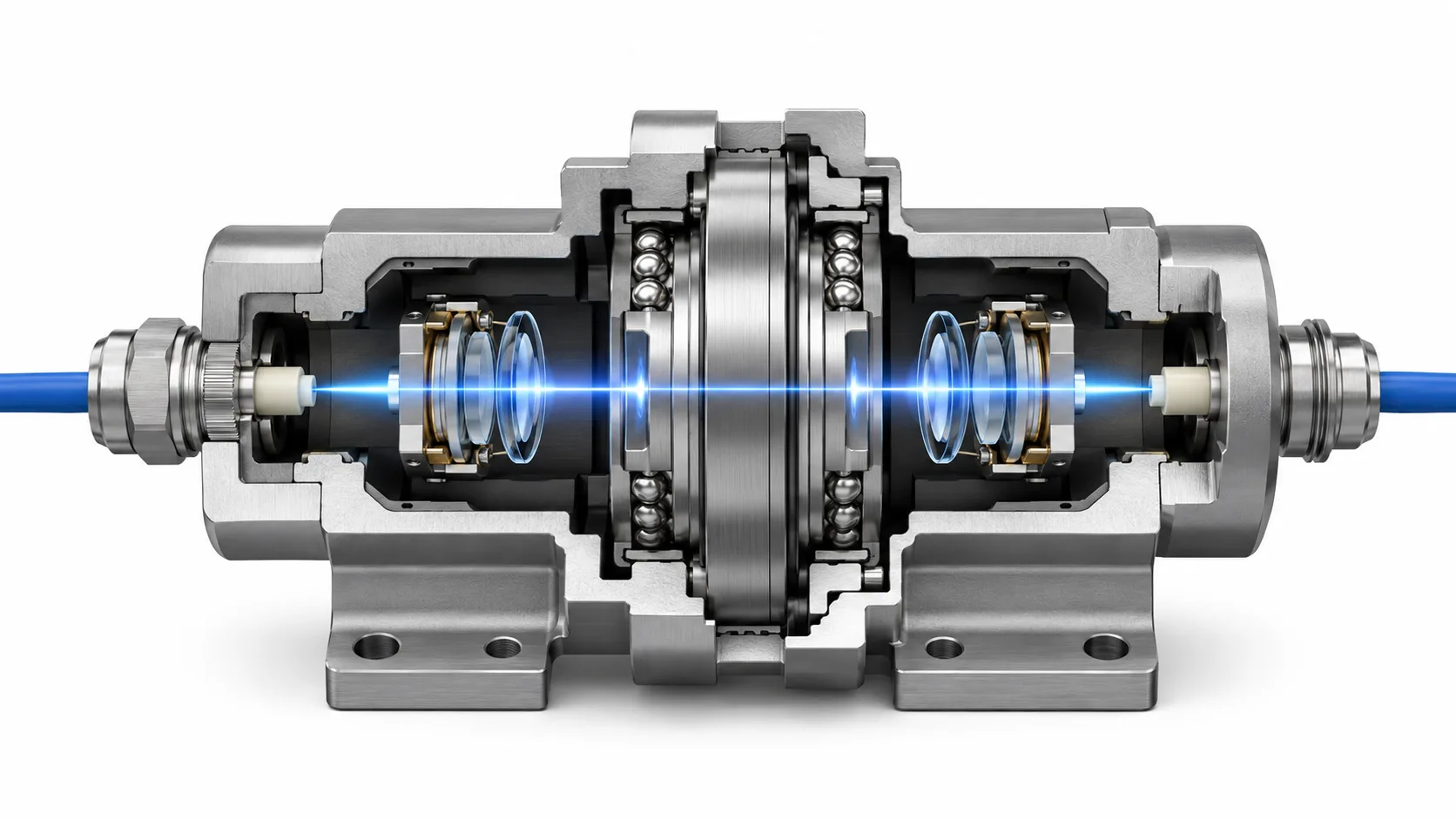
A fiber optic rotary joint is a passive optical device that allows light to pass between the stationary and rotating sides of a machine without breaking the optical path. It plays the same role for optical signals that a conventional slip ring plays for electrical signals.
You will see the same technology described in datasheets and RFQs under several names:
- Fiber optic rotary joint (FORJ)
- Fiber optic slip ring
- Optical slip ring
- Optical rotary joint
- Fiber optic rotary connector
These terms generally describe the same function. The naming usually reflects the industry and the supplier rather than a technical difference.
How a Fiber Optic Rotary Joint Works
Inside a FORJ, the rotating fiber and the stationary fiber never physically twist against each other. Instead, the optical signal is transferred through a precisely aligned optical path between two collimating elements, supported by bearings, a rotating housing and a stationary housing. Single-channel designs typically use a pair of collimators on the rotation axis. Multi-channel designs add prisms, dove prisms, mirrors, or rotary multiplexers so that several optical channels can share or cross the same rotating interface.
Because optical transmission depends on micron-level alignment, the mechanical quality of the bearings and the dimensional stability of the housing matter as much as the optics themselves. In high-speed or vibration-prone applications, the dominant failure mode is not catastrophic loss of signal but unstable insertion loss variation: the part passes a static test on the bench, then drifts in the field once it starts rotating under load.
Hybrid Fiber Optic Slip Ring: Power, Signal and Optical Data in One Assembly
A FORJ by itself only transmits optical signals. It does not carry electrical power, motor drive current, encoder signals or pneumatic lines. In real machines, those almost always have to cross the same rotating axis.
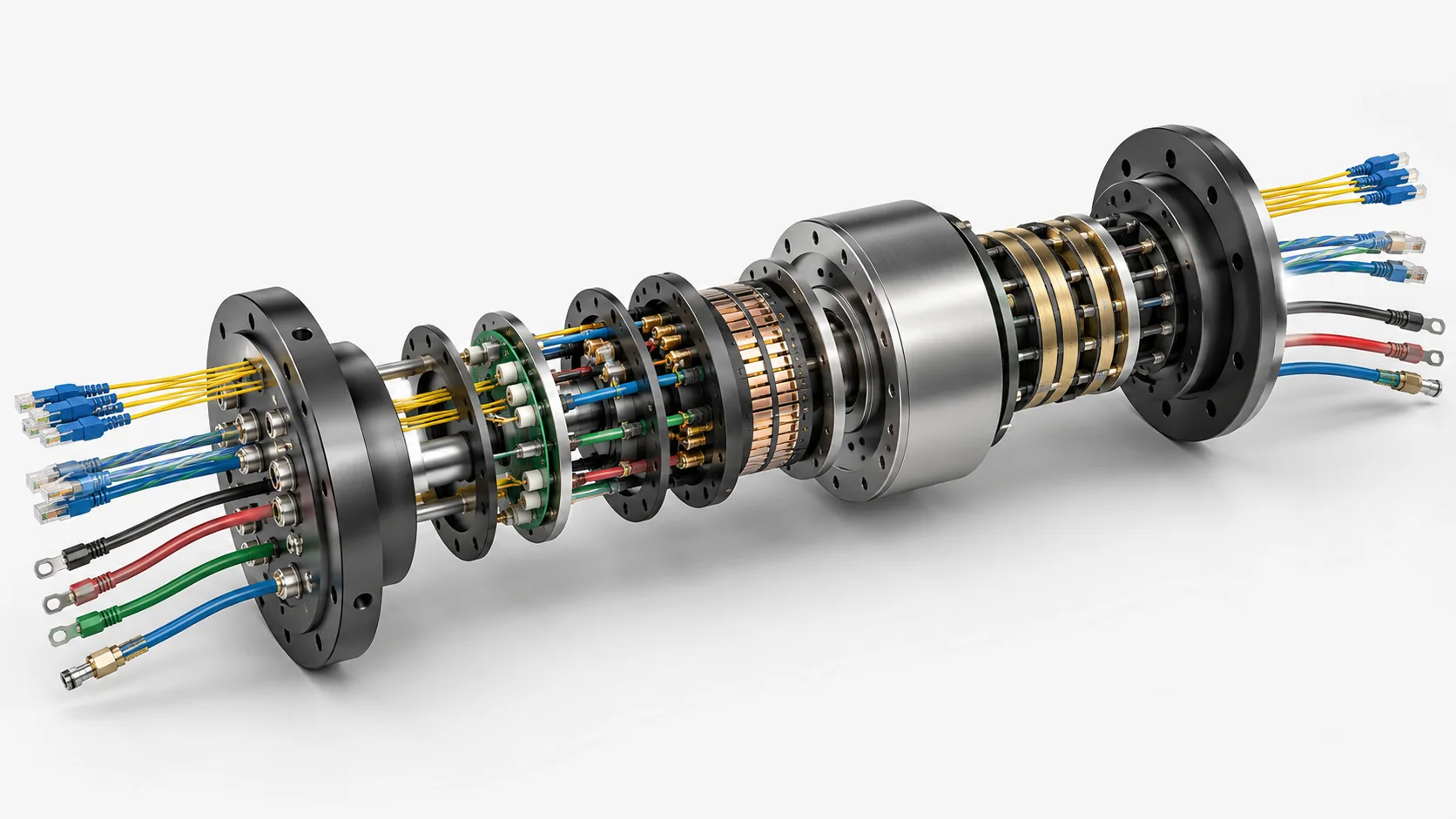
That is why most of the FORJ requests we receive are not for a bare FORJ. They are for a hybrid slip ring that integrates the optical channel with an electrical slip ring, and sometimes with a pneumatic or hydraulic line, inside one mechanical envelope.
A hybrid fiber optic slip ring typically combines some of the following in a single rotary assembly:
- One or more optical channels (single-mode or multimode)
- High-current power circuits for motors or heaters
- Low-voltage control and sensor signals
- Gigabit Ethernet or fieldbus circuits (CAN, EtherCAT, PROFINET)
- RF or coaxial channels
- Pneumatic or hydraulic passages in some designs
When a Hybrid Slip Ring Makes Sense
A hybrid design is usually the right answer when at least one of the following is true:
- The rotating structure has strict envelope, weight or balance constraints, and a second rotary device cannot be stacked on the shaft.
- The data link must be immune to electromagnetic interference from nearby motors, VFDs or radar transmitters.
- The data rate exceeds what a copper slip ring contact can deliver reliably over the life of the system.
- Power, motion control and high-bandwidth sensor data all need to cross the same axis.
- The application is custom enough that an off-the-shelf FORJ and a separate slip ring would not align mechanically.
In a surveillance gimbal, for example, a typical hybrid assembly might combine one optical channel for the camera's high-resolution video stream, a Gigabit Ethernet line for control, several amperes of power for pan/tilt motors and heaters, and a handful of low-voltage signal circuits, all inside a housing under 60 mm in diameter. Specifying these channels separately and bolting them together usually costs more space and more money than a single integrated design.
Fiber Optic Rotary Joint vs. Electrical Slip Ring
Both devices solve rotary transmission problems, but they are not interchangeable.
| Factor | Fiber Optic Rotary Joint | Electrical Slip Ring |
|---|---|---|
| Primary signal | Optical data | Power and electrical signals |
| Best for | High-bandwidth data, EMI-sensitive links, long fiber runs | Power transfer, low-voltage control, sensor signals |
| Contact method | Contactless optical path | Brush-on-ring or fiber brush contact |
| EMI sensitivity | Very low | Depends on shielding and signal type |
| Transmits power? | No | Yes |
| Key parameters | Fiber type, wavelength, channel count, insertion loss, return loss | Current, voltage, contact material, circuit count |
| Common combination | Integrated into a hybrid slip ring | Integrated with FORJ, RF or pneumatic modules |
If the system only needs power and standard control signals, a conventional electrical slip ring is enough. The moment you need to push uncompressed HD/4K video, sustained Gigabit Ethernet, or any high-bandwidth optical sensor across a rotating axis, a FORJ or hybrid assembly becomes the more reliable long-term choice.
Key Specifications That Actually Matter
Choosing a FORJ is not just a question of outer diameter and price. The optical, mechanical and environmental requirements have to be reviewed together, because trade-offs between them drive most field failures.
Single-Channel vs. Multi-Channel
A single-channel FORJ transmits one optical channel. It is smaller, simpler, and generally has the lowest insertion loss and the best long-term stability. A multi-channel FORJ transmits multiple optical channels through the same rotating interface, using prisms, dove prisms or multiplexers depending on the design.
Multi-channel FORJs solve a real problem but they add complexity, alignment sensitivity and cost. Before committing to a 4- or 8-channel design, it is worth asking whether the data could be multiplexed onto one or two fibers at the transceiver level instead. Wavelength division multiplexing or higher-rate transceivers often reduce the required channel count and result in a smaller, more reliable rotary joint.
Single-Mode vs. Multimode Fiber
The fiber type has to match the rest of the optical system. Single-mode fiber (typically OS2, aligned with the ITU-T G.652 recommendation) is used for long-distance, high-bandwidth and telecom-grade links, often at 1310 nm or 1550 nm. Multimode fiber (OM3/OM4/OM5) is more common in short data links at 850 nm and is generally cheaper to terminate.
For a FORJ, the choice usually follows from the transceivers and the optical budget of the system. Mixing fiber types across the rotary interface is a frequent cause of unexplained loss, so always confirm the fiber type, the operating wavelength and the connector type on both sides before ordering.
Insertion Loss, Return Loss and Signal Stability
Optical performance is where most low-cost FORJs underperform. The numbers worth looking at:
- Insertion loss - typical good single-mode FORJ: under about 1.5 dB. Be careful with parts quoted only at "typical" values without a maximum.
- Insertion loss variation during rotation - this is often more important than the static insertion loss. Look for variation under 0.5 dB across a full revolution, measured at rated speed, not at standstill.
- Return loss - for single-mode systems, 50 dB or better is usually expected. Low return loss can destabilize laser transmitters and corrupt the link.
- Wavelength dependence - confirm performance at your actual operating wavelength, not just at a single reference wavelength.
- Crosstalk - relevant for multi-channel designs only.
Ask the supplier for a test report showing dynamic insertion loss measured while the joint is rotating. A part that looks acceptable on a static bench test can drift several dB once it is spinning under load.
Rotation Speed, Torque and Mechanical Envelope
The FORJ has to physically fit and survive in the machine. Confirm the rated continuous speed, peak speed, starting torque, axial and radial load capacity, and bearing service life. A compact single-channel FORJ may be rated for several thousand RPM, while a sealed multi-channel design for marine use will typically be limited to a few hundred RPM in exchange for environmental protection.
IP Rating, Temperature and Environment
Sealing requirements are driven by where the assembly operates, not by how it looks on a CAD model. Outdoor radar pedestals, ROV systems, offshore winches and wind turbine nacelles each have different exposure profiles for water, salt spray, dust and condensation.
For protection ratings, refer to the IEC 60529 standard, which underpins the IP rating system used across the industry. As a rule of thumb: IP54 is fine for clean indoor industrial environments, IP65/IP66 for outdoor or washdown exposure, and IP67/IP68 for prolonged immersion. Asking for IP68 in a clean room only adds cost; asking for IP54 on an offshore deck will fail in the first storm.
Connectors, Pigtails and Mounting
Small integration details are responsible for a surprising share of project delays. Before ordering, confirm:
- Connector type on each side: FC/APC, FC/UPC, SC, ST, LC, SMA or custom
- Pigtail length and the cable jacket required for your environment
- Cable exit direction - straight or right-angle
- Bend radius limits along the cable run
- Flange pattern, threaded mounting or shaft fit
- Whether the FORJ must be integrated with an existing slip ring or built into a new assembly
Quick FORJ Selection
The following table is the short version we use internally when scoping new inquiries.
| Your Situation | Recommended Direction |
|---|---|
| Optical data only, no power across the axis | Standalone FORJ |
| Optical data + power, motor control or Ethernet across the same axis | Hybrid slip ring with integrated FORJ |
| Long-distance link, high bandwidth, telecom wavelengths | Single-mode FORJ (OS2, 1310/1550 nm) |
| Short data link, lower cost, 850 nm transceivers | Multimode FORJ (OM3/OM4) |
| Multiple optical paths needed | Multi-channel FORJ - or evaluate WDM/multiplexing first |
| Outdoor, marine, offshore, washdown | Sealed FORJ, typically IP66 or higher |
| Continuous high-speed rotation (gimbals, radar) | Compact single-channel FORJ with low insertion loss variation |
| Strict envelope, weight or balance limits | Custom hybrid assembly |
FORJ Selection
Use this checklist when preparing an RFQ. Each row maps a requirement to a concrete question to ask the supplier.
| Requirement | What to Confirm | Why It Matters |
|---|---|---|
| Fiber type | Single-mode or multimode, OS2 / OM3 / OM4 / OM5 | Mismatched fiber causes excess loss and bandwidth limits |
| Wavelength | 850 / 1310 / 1550 nm or your specific transceiver | Performance is wavelength-dependent |
| Channel count | Number of independent optical channels needed | Drives complexity, size and cost |
| Insertion loss | Maximum value, not typical | Defines the link budget |
| Insertion loss variation | Tested during rotation at rated speed | Static loss alone hides real-world performance |
| Return loss | Minimum dB, especially for single-mode | Low return loss can destabilize laser sources |
| Rotation speed | Continuous and peak RPM | Drives bearing and seal selection |
| IP rating | Specific IP code, not "waterproof" | Sealing standard is verifiable, marketing terms are not |
| Temperature range | Operating and storage extremes | Affects lubricant, seal and adhesive selection |
| Connector type | FC/APC, FC/UPC, SC, LC, ST, SMA | Determines mating compatibility |
| Mounting | Flange, shaft, through-bore or custom | Decides whether the part fits at all |
| Other channels | Power, control, Ethernet, RF, pneumatic | Points to a hybrid assembly |
How to Choose the Right FORJ
This is the process our application engineers use when scoping a new FORJ project with a customer.
Map the Full Transmission Requirement
List every signal that has to cross the rotating axis: optical channels, power circuits, control signals, Ethernet, fieldbus, RF, pneumatic or hydraulic lines. If anything beyond pure optical data is on the list, you are looking at a hybrid assembly, not a standalone FORJ.
Lock Down the Optical System
Specify fiber type, wavelength, connector type, number of optical channels, maximum insertion loss, return loss and allowable insertion loss variation. If you are unsure whether you really need multiple optical channels, ask whether multiplexing or a higher-rate transceiver can collapse the requirement into one or two channels. This single decision often saves the most cost and complexity.
Confirm the Mechanical Envelope
Send a basic drawing or at minimum an envelope: outer diameter, length, bore size, mounting interface, cable exit direction, rotation speed and any torque limits. A FORJ with perfect optics is useless if it does not fit on the shaft.
Match the Environment to a Real IP Code
State exactly where the assembly will operate: indoor, outdoor, marine, downhole, vacuum, high humidity, salt spray, dust, chemical exposure. Convert that into an IP code and an operating temperature range. Avoid using vague terms like "waterproof" or "rugged" - they cost extra and verify nothing.
Define the Test and Documentation You Need
For critical systems (medical imaging, aerospace, defense, offshore), request the documentation up front rather than after delivery:
- Optical test report at the operating wavelength
- Dynamic insertion loss data during rotation
- Return loss measurement
- Mechanical drawing and fiber pinout
- Material declaration and surface treatments
- Recommended installation and maintenance procedure
Defining these at quotation stage prevents most of the disputes that otherwise show up at acceptance testing.
Real-World Application Scenarios
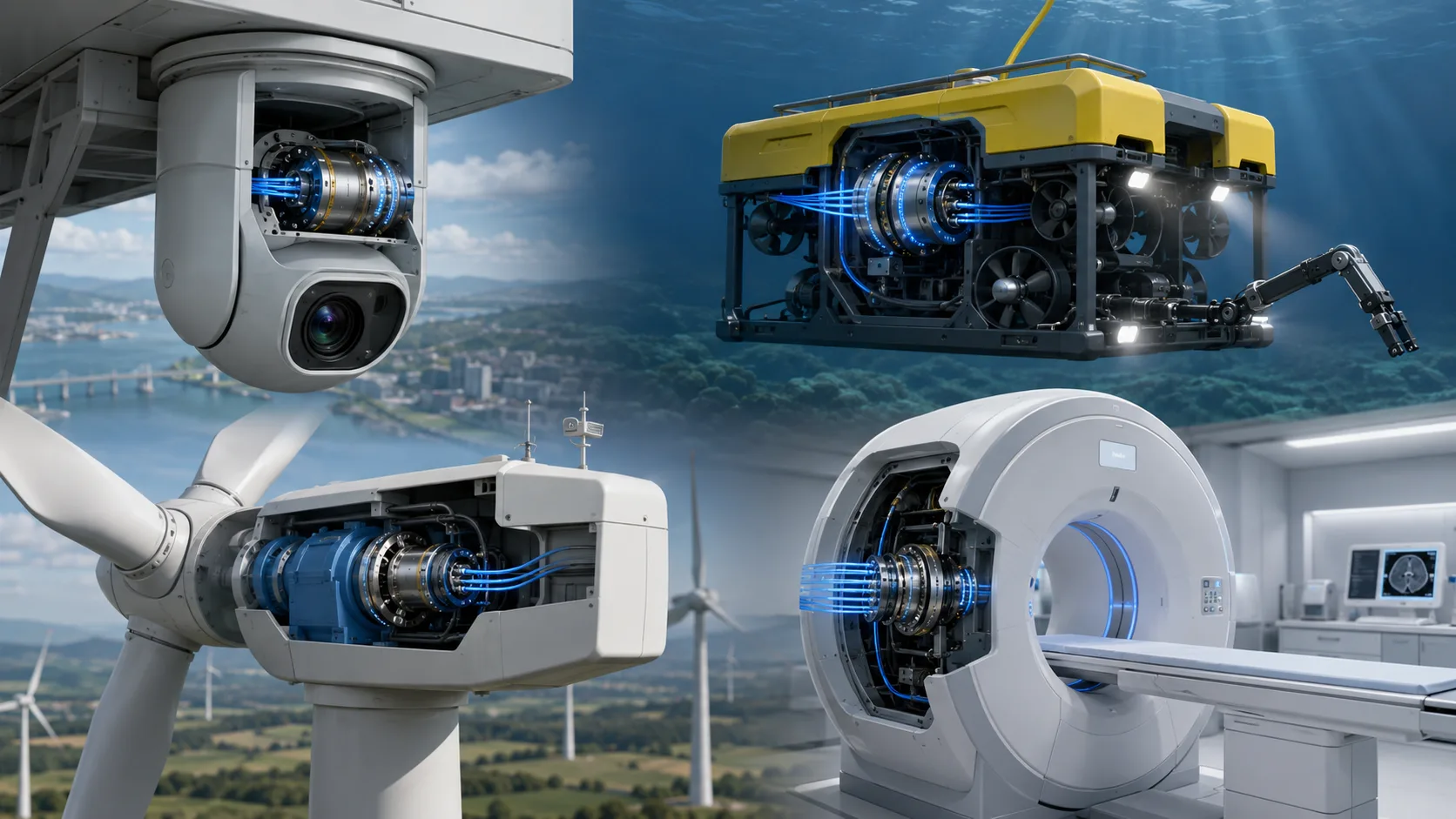
Surveillance and Targeting Gimbals
A typical EO/IR gimbal needs uncompressed video from sensors mounted on the rotating head back to the base. Copper contacts struggle with the data rate, EMI from the pan/tilt motors corrupts the signal, and the available envelope is small. A hybrid FORJ combining one optical channel for video, Gigabit Ethernet for control and 24 VDC motor power is the standard solution.
Remotely Operated Vehicles (ROVs)
Subsea systems need sealed assemblies that survive salt water, pressure cycling and continuous low-speed rotation on winches or manipulator joints. Insertion loss and IP rating dominate the specification, while top rotation speed is rarely the limiting factor.
Wind Turbines and Radar Pedestals
For nacelle yaw systems and radar antenna pedestals, the assembly typically runs at low RPM but must operate for many years with minimal maintenance. Insertion loss stability over thousands of hours, sealed bearings and proven IP66 housings are more important than peak optical performance.
Medical Imaging Systems
CT and OCT systems combine high data rates with extremely strict reliability requirements. The FORJ here is usually one element of a tightly integrated hybrid rotary assembly, qualified together with the rest of the machine rather than specified in isolation.
FAQ
Q: What Does FORJ Stand For?
A: FORJ stands for Fiber Optic Rotary Joint, a device that allows optical signals to pass between the stationary and rotating sides of a machine without twisting the fiber.
Q: Is A Fiber Optic Rotary Joint The Same As A Slip Ring?
A: Not exactly. A FORJ does for optical signals what a slip ring does for electrical signals. In most modern systems, the two are combined into a hybrid rotary assembly.
Q: Can A Fiber Optic Rotary Joint Transmit Power?
A: No. A FORJ only transmits optical signals. If you also need power, control signals or Ethernet on the same axis, you need a hybrid slip ring that integrates a FORJ with an electrical slip ring.
Q: When Should I Use A FORJ Instead Of An Electrical Slip Ring?
A: Whenever the link must carry high-bandwidth data, must be immune to EMI, or must travel a long distance through optical fiber. Electrical contacts can carry data, but at multi-gigabit rates and in noisy environments, optical transmission is almost always more reliable.
Q: What Is The Difference Between A Single-Mode And Multimode FORJ?
A: A single-mode FORJ is matched to single-mode fiber and is typically used for high-bandwidth or long-distance links at 1310 or 1550 nm. A multimode FORJ is matched to multimode fiber (OM3/OM4) and is more common in shorter 850 nm data links.
Q: What Insertion Loss Should I Expect From A Good FORJ?
A: For a single-channel single-mode FORJ, insertion loss under approximately 1.5 dB and insertion loss variation under 0.5 dB during rotation are reasonable targets. Multi-channel and harsh-environment designs will typically have higher values. Always ask for maximum, not typical, numbers.
Q: What Information Should I Provide When Requesting A FORJ Quote?
A: Fiber type, wavelength, connector type, number of optical channels, rotation speed, mounting interface, IP rating, operating temperature, and whether power or signal circuits also need to cross the same axis. The more of this defined upfront, the more accurate the quote.
Next Steps
A fiber optic rotary joint is rarely a catalog purchase. In production systems it is one element of a hybrid rotary assembly that has to balance optical performance, mechanical fit, environmental sealing and integration with the rest of the machine.
If you are scoping a new design or need a second opinion on an existing FORJ specification, prepare the items from the selection checklist above - fiber type, wavelength, channel count, insertion loss target, rotation speed, IP rating and any additional power or signal channels - and share them with our application engineering team. We will respond with a concrete proposal, including dynamic test data and a mechanical concept, rather than a generic datasheet.