

Introduction
Semiconductor manufacturing demands ultra-precise and reliable equipment. Slip rings, the rotary electrical connectors, enable continuous transmission of power, signals, and media in rotating parts of semiconductor machines. They directly affect the quality and yield of silicon wafers used in microprocessors, memory chips, and other integrated circuits.
In this guide, we'll talk about the types of semiconductor slip rings, their specific applications, requirements, and practical tips for selecting the right one.
What are Semiconductor Slip Rings?
Semiconductor slip rings are specialized rotary electrical connectors designed for the extreme conditions of semiconductor production. Unlike general industrial slip rings, they must operate reliably in cleanrooms, vacuum environments, and under strict contamination control, while supporting multi-channel transmission of power, data, and fluids.
Main Types of Semiconductor Slip Rings

Through-Hole Slip Rings
Designed with a central hole, hollow shaft slip rings enable shaft-like components to pass through. They offer low torque and low signal loss, ideal for rotating polishing heads in Chemical Mechanical Polishing (CMP) machines and rotating targets in Physical Vapor Deposition (PVD) systems.
Capsule Slip Rings
Compact and axially connected, capsule slip rings suit small semiconductor testing devices with moderate rotation speeds. They provide multiple independent channels for power and signal transmission in tight spaces.
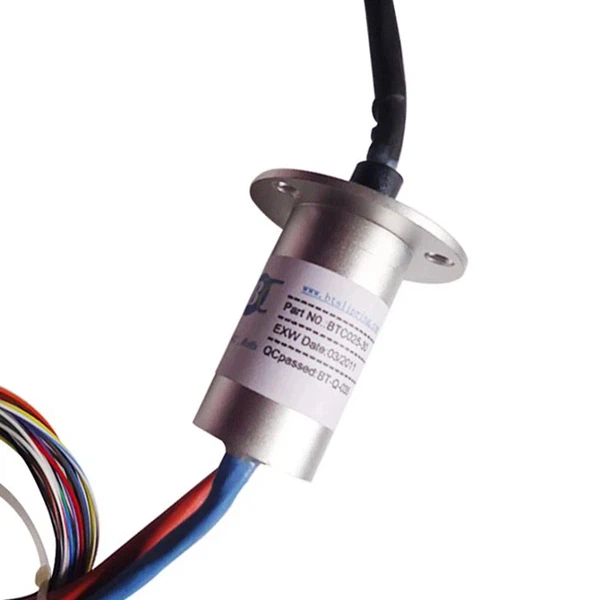

Pancake Slip Rings
Featuring a disc-shaped conductive ring layout, pancake slip rings support higher current loads with less brush wear. They are commonly found in large wafer handling robots and vacuum coating equipment.
Mercury Slip Rings
Using liquid mercury as the conductive medium, these slip rings are suitable for high-speed applications like semiconductor lithography equipment. They resist vibration well but require careful handling due to mercury's toxicity.

Applications of Slip Rings in Semiconductor Manufacturing

Provide 360° rotation for precise chip placement and micro-assembly with ±0.1μm accuracy.

Enable electrical connections and sensor signal transmission for polishing heads rotating at 500+ rpm.

Support multi-angle joint rotation with stable signal feedback, often integrating brushless mercury slip rings.

Transmit power and sensor data within vacuum chambers at pressures as low as 10⁻⁶ Pa.

Deliver power and sensor signals to rotating wafer carriers, ensuring uniform thin film deposition.
How to Choose the Right Semiconductor Slip Ring?
1. High Cleanroom Compatibility: It should reach IP67/IP68 sealing to resist dust, chemicals, and wet environments in Class 100 cleanrooms.
2. Miniaturization & Integration: Its diameter is often under 10mm, supporting power, high-speed data (e.g., EtherCAT), and media transmission simultaneously.
3. Compliance with Industry Standards: This includes SEMI S2/S8, IEC 60529, IEC 60068, RoHS/REACH, and EMC standards (CISPR 32).
4. Material & Lubricants: We generally use precious metals and alloys (Au-Ni, Pd-based) for them, with perfluoropolyether (PFPE) lubricants for reduced wear.
5. Vacuum Compatibility: Check the slip ring thermal Management, that is, whether it uses heat sinks and volatile-free materials to handle heat dissipation in vacuum environments.
6. Wide Operating Temperature Range: The slip ring should withstand temperatures from -40°C up to 200°C or higher to suit heat treatment or cryogenic processes.
7. Mixed Transmission Capabilities: Sometimes you'll require hybrid designs integrating electrical, fiber optic, and fluid/gas channels.
Why Choose ByTune Semiconductor Slip Rings?
With 27 years of engineering experience, ByTune delivers premium slip rings designed for the demanding semiconductor device:
- Up to 10,000 RPM operational speed
- Operating temperature from -40°C to 300°C
- IP68 sealing and advanced cooling options (air/water)
- Flexible wiring, including CAT, coaxial, and shielded cables
- Customized installation styles and hybrid multi-media transmission
As your trustworthy partner, ByTune is ready to provide slip ring solutions that meet the specific parameters of your semiconductor manufacturing equipment.
FAQs
Q: Can semiconductor slip rings operate in vacuum environments?
A: Yes, ByTune slip rings are designed for vacuum compatibility with materials and lubricants that prevent contamination and overheating.
Q: What is the typical lifespan of a semiconductor slip ring?
A: Depending on operating conditions and materials, slip rings can last nearly 10-15 years or longer with minimal maintenance.
Q: How do I ensure the slip ring supports high-speed data transmission?
A: Choose slip rings integrated with fiber optic modules or shielded cables compliant with EMC standards.
Conclusion
Semiconductor slip rings help to keep the precision, reliability, and efficiency of modern semiconductor manufacturing equipment. Understanding their types, applications, and industry requirements is important. Cause it makes you able to select the optimal slip ring solution for your needs.
Get Your Customized Semiconductor Slip Ring Solutions
Need a slip ring solution tailored to your semiconductor manufacturing equipment? As a leading slip ring supplier, ByTune offers any what you want for your application. Contact ByTune's technical team today to discuss your project requirements, request samples, and get expert advice.