

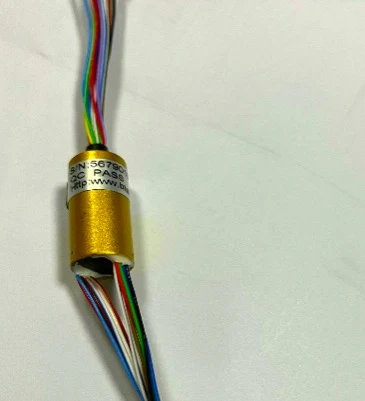
How Do Miniature Slip Rings Work?
Miniature slip rings transfer electrical power and signals between stationary and rotating parts through continuous metal-to-metal contact. Inside the compact housing, stationary brushes press against rotating conductive rings, maintaining electrical connection as the device spins.
The Core Mechanism
The working principle centers on a deceptively simple contact system. A miniature slip ring contains two primary components: conductive metal rings attached to a rotating shaft, and stationary brushes that press against these rings. As the shaft rotates, the brushes maintain constant contact with the ring surfaces, creating an unbroken electrical pathway.
Think of it like a record player, but for electricity. The rings are like the record grooves, and the brushes are like the needle-always in contact, always conducting, no matter how much rotation occurs.
The rings themselves are typically made from brass, copper, or precious metals like gold and silver, chosen for their excellent electrical conductivity. These materials form concentric circles mounted on an insulated central shaft. Each ring represents an independent electrical circuit, allowing multiple signals or power lines to pass through simultaneously.
The brushes-usually made from silver-graphite composites or pure precious metals-are held in position by spring mechanisms. This spring pressure is carefully calibrated. Too much pressure creates excessive friction and wear; too little results in intermittent contact and electrical noise. Most miniature units maintain brush pressures between 15-30 grams per contact point.
Size and Scale
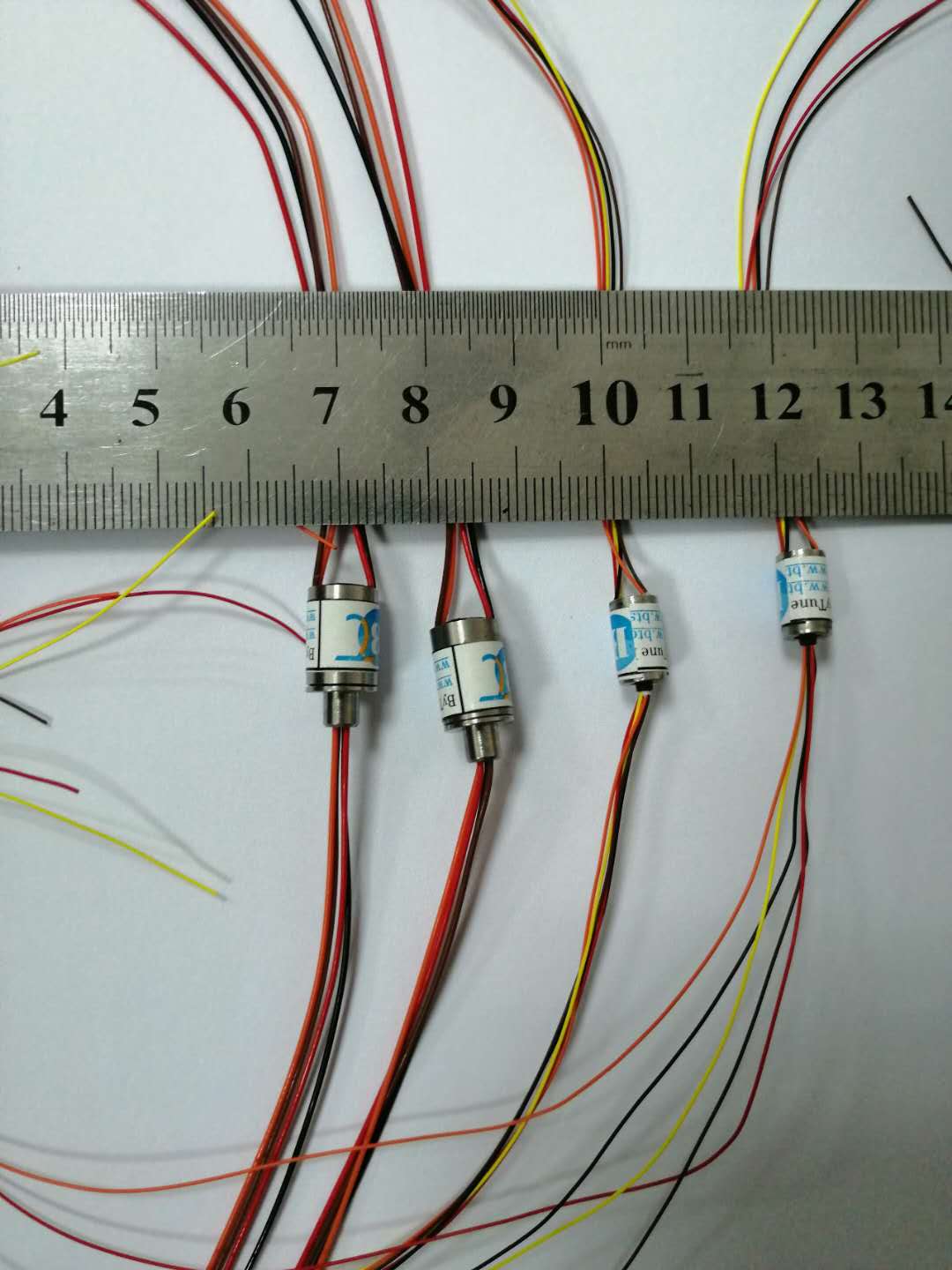
The "miniature" designation typically applies to slip rings with outer diameters under 12.5mm, though some manufacturers extend this to 16mm. The smallest commercially available units measure just 6.5mm in diameter-about the size of a pencil eraser-yet can handle 2-12 independent electrical circuits.
This compact size doesn't mean limited capability. A typical 12mm miniature slip ring can transmit up to 240V and 2A per circuit while rotating at speeds up to 300 RPM. Specialized high-performance models handle even more demanding specifications, with some supporting currents up to 50A and voltages reaching 440V.
The physical construction reflects sophisticated engineering. Inside the tiny capsule, rings are stacked with spacing as tight as 0.015 inches between adjacent circuits. Precision manufacturing ensures each ring maintains perfect concentricity with the rotation axis-any wobble or eccentricity would cause the brushes to bounce, creating electrical noise and accelerating wear.
Material Science Behind the Contact
The choice of contact materials directly determines performance characteristics. Silver-graphite brushes on brass rings represent the standard configuration, balancing cost with acceptable electrical noise levels. This combination produces contact resistance typically under 50 milliohms and can handle moderate current loads.
For applications demanding higher signal integrity, manufacturers use gold-on-gold contacts. Gold's resistance to oxidation means consistent contact resistance over time, even during periods of inactivity. These premium contacts are essential in medical imaging equipment and aerospace applications where signal degradation cannot be tolerated.
The graphite component in composite brushes serves multiple purposes. It provides self-lubrication, reducing friction and wear. It also creates a thin conductive film on the ring surface that actually improves electrical contact. This film, maintained through continuous operation, explains why slip rings often exhibit lower noise after a brief break-in period.
Copper-graphite composites offer higher current capacity than silver-graphite alternatives, making them suitable for power transmission rather than sensitive signal applications. The trade-off is slightly higher electrical noise and contact resistance.
Electrical Performance Characteristics
Contact resistance represents one of the most critical specifications. In miniature slip rings, this typically ranges from 1-50 milliohms depending on materials and design. This resistance creates a small voltage drop as current flows through the brush-ring interface. At 2A, a 20-milliohm contact resistance produces a 40-millivolt drop-negligible for power applications but potentially significant for low-level signal transmission.
Electrical noise manifests as fluctuations in contact resistance as the ring rotates. These variations, measured in microvolts or millivolts, can interfere with data signals. High-quality miniature slip rings achieve noise levels below 10 milliohms variation at typical rotation speeds. Gold contacts and precision manufacturing reduce this further, with premium units achieving noise levels under 1 milliohm.
Insulation resistance between adjacent circuits must be extraordinarily high-typically exceeding 1000 megohms at 500V DC. This prevents crosstalk between signals and ensures safety. The insulating materials separating rings are carefully selected polymers or ceramics that maintain their properties across the operating temperature range of -30°C to +80°C.
Dynamic Behavior During Rotation
As rotation begins, the brush-ring interface undergoes complex mechanical and electrical changes. Initial static friction gives way to kinetic friction. The brush begins generating microscopic vibrations-typically at frequencies related to surface imperfections on the ring multiplied by rotation speed.
These vibrations affect electrical contact. At low speeds (under 50 RPM), the brush maintains relatively steady contact with predictable resistance. As speed increases to 200-300 RPM-the typical operating range for miniature slip rings-the brush may experience brief micro-separations measured in microseconds. Modern designs use multiple brush contacts per ring to ensure at least one brush maintains contact at any given moment.
The rotational speed limit isn't arbitrary. At higher speeds, centrifugal forces begin affecting brush pressure distribution, especially in smaller diameter rings where centrifugal acceleration becomes significant relative to spring pressure. Brush bounce increases, generating electrical noise and accelerating wear. Heat generation from friction also increases with the square of velocity, requiring careful thermal management above 300 RPM.

Common Applications
Miniature slip rings excel in space-constrained applications requiring continuous rotation. Security cameras use them extensively-a pan-tilt-zoom camera needs to rotate indefinitely while maintaining power and transmitting video signals. A typical CCTV application uses 6-8 circuits: two for power, two for video signals, and the remainder for control signals.
Medical equipment represents another major application area. Dental examination lights that rotate freely around the patient's head use miniature slip rings to provide power without cable entanglement. CT scanners-though typically using larger slip rings for the gantry-may use miniature versions for subsystems.
Drones and robotic systems integrate miniature slip rings in gimbals and rotating sensor assemblies. A 3-axis gimbal stabilization system might use three separate miniature slip rings, one for each axis of rotation. These applications demand extremely low torque-often less than 5 gram-centimeters-to avoid interfering with servo motor control.
Stage lighting, especially moving head fixtures, relies on miniature slip rings to power and control LED arrays and motors while the fixture pans and tilts continuously. These applications typically require 12-24 circuits handling mixed signal types: high-current power lines alongside low-voltage DMX control signals.
Assembly and Integration
Installation of miniature slip rings requires attention to mechanical alignment. The rotating shaft must be precisely centered on the slip ring's axis of rotation. Eccentricity as small as 0.1mm can cause excessive brush wear and electrical noise. Most miniature units include integrated ball bearings to maintain alignment, though the slip ring itself shouldn't bear significant radial or axial loads.
Mounting configurations come in two primary styles. Flange-mount versions have a stationary housing with pre-drilled holes for attachment, with the rotor extending from one side. Through-bore designs feature a hollow center shaft, allowing mechanical components or other elements to pass through the center-useful when the slip ring must be mounted on an existing shaft.
Wire management matters more than it might appear. The wire leads from both rotor and stator must be routed to prevent tangling or stress. Color-coded wires simplify connection, with matching colors on rotor and stator sides indicating corresponding circuits. Many miniature slip rings use 26-28 AWG wire, flexible enough for tight bends but substantial enough to handle rated currents.
Maintenance and Lifespan
One of the key advantages of miniature slip rings is their maintenance-free operation over extended periods. Typical service life ranges from 10 million to 100 million revolutions, depending on materials, speed, and current loading. At 100 RPM continuous operation, 10 million revolutions translates to roughly 190 days of operation-sufficient for most applications before scheduled maintenance windows.
The capsule design of most miniature slip rings means they cannot be disassembled for cleaning or brush replacement. They're designed as consumable components, replaced entirely when performance degrades. This approach simplifies inventory and reduces installation labor, though it requires keeping spare units on hand for critical applications.
Environmental protection varies by model. Standard miniature slip rings are rated for indoor use in relatively clean environments. They're vulnerable to dust ingress, which can interfere with brush contact and accelerate wear. Versions with improved sealing achieve IP54 or IP65 ratings, protecting against dust and moisture-essential for outdoor equipment or industrial environments.
Signal Integrity Considerations
For data transmission applications, signal integrity becomes paramount. Miniature slip rings can successfully transmit various signal types, but each has specific requirements. Analog video signals tolerate the small voltage variations of slip ring contact, though premium units with gold contacts are preferred for high-definition applications.
Ethernet signals pose greater challenges. Fast Ethernet (100Mbps) and Gigabit Ethernet require maintaining signal impedance and minimizing reflections. Specialized miniature slip rings designed for Ethernet use differential pair routing and impedance matching, though they cost significantly more than standard units.
USB and other high-speed serial protocols can be transmitted through slip rings, but the contact resistance and inductance of the brush-ring interface limit maximum data rates. USB 2.0 (480 Mbps) is achievable with quality miniature slip rings, while USB 3.0 speeds typically require larger, more specialized designs.
Low-level sensor signals-thermocouple voltages, strain gauge outputs, or pH probe signals measured in millivolts-demand the lowest noise slip rings with gold contacts. Even microvolts of contact noise can corrupt these sensitive measurements.
Thermal Management
Heat generation in miniature slip rings comes from two sources: resistive heating from current flow through the contact resistance, and frictional heating from mechanical sliding. Both are proportional to current and speed, respectively.
A miniature slip ring carrying 2A through a 20-milliohm contact generates 80 milliwatts of resistive heat per circuit. With 6 circuits, that's 480 milliwatts total. While seemingly small, this concentrated in a 12mm diameter package can raise internal temperatures significantly above ambient.
The compact size actually aids thermal management in some ways. The high surface-area-to-volume ratio allows relatively efficient heat dissipation through natural convection. Most miniature slip rings operate comfortably at ambient temperatures up to 60°C, with internal temperatures reaching 80-90°C under full load.
Exceeding thermal limits accelerates wear. Elevated temperatures soften the brush materials and can degrade the insulation between circuits. Applications requiring continuous high-current operation may need forced air cooling or heat sinking attached to the slip ring housing.
Advanced Variants
Hybrid miniature slip rings combine electrical transmission with pneumatic or hydraulic passages. These specialized units-typically larger than pure electrical versions at 30-40mm diameter-can transmit up to 12 electrical circuits alongside 1-4 fluid or gas passages. Applications include automated welding systems that need electrical power plus shielding gas delivery to rotating components.
Fiber optic slip rings represent another evolution, transmitting optical signals rather than electrical. While typically larger than 12.5mm, some miniature fiber optic rotary joints exist for applications demanding extremely high bandwidth or immunity to electromagnetic interference. These use precision-aligned lenses or beam expansion techniques to maintain optical coupling across the rotating interface.
Wireless slip rings-technically not slip rings at all-use inductive or capacitive coupling to transmit power and data without physical contact. While they eliminate wear and maintenance, their power capacity remains limited compared to contact-based designs. A miniature inductive slip ring might transfer 10-50 watts, whereas a contact-based equivalent handles 100-500 watts.
Failure Modes and Troubleshooting
Gradual performance degradation is normal and expected. Contact resistance slowly increases as the brush and ring surfaces wear. Electrical noise levels rise as surface imperfections develop. These changes occur over millions of revolutions and don't indicate imminent failure-just progressive aging.
Sudden performance changes suggest specific problems. Intermittent connection or spikes in contact resistance often indicate contamination-dust particles or debris trapped between brush and ring. In sealed environments, this might result from wear debris accumulation. Operation outside the rated speed or current specifications accelerates this contamination.
Complete circuit failure typically results from brush wear-through. The brush material is designed to wear preferentially compared to the ring, protecting the more expensive ring surface. When a brush wears to its minimum height, spring pressure decreases and contact becomes unreliable. This failure mode is predictable based on service life ratings.
Excessive noise or vibration during rotation can indicate mechanical issues: bearing wear, shaft misalignment, or mounting problems. These mechanical problems accelerate electrical contact degradation and should be addressed promptly.
Specification Selection
Choosing the appropriate miniature slip ring begins with circuit requirements. Count the number of independent electrical paths needed, keeping in mind that each signal typically requires two wires (signal and ground/return). A device requiring +5V power, ground, and three sensor signals needs at least 5 circuits.
Current requirements for each circuit must fall within the slip ring's rating, with appropriate derating for continuous vs. intermittent use. A slip ring rated for 2A continuous can often handle 3-4A for brief periods, but sustained operation above rating accelerates wear and causes overheating.
Voltage ratings must accommodate not just normal operating voltage but also any transients or surge conditions. A 24V DC system might experience 40V transients, requiring a slip ring with at least 50V rating for adequate margin.
Rotational speed in the application must not exceed the slip ring's rating. While exceeding speed ratings occasionally might not cause immediate failure, it significantly reduces service life and increases electrical noise. Applications with variable speed should specify based on maximum continuous speed, not average.
Cost-Performance Trade-offs
Standard miniature slip rings with copper-graphite or silver-graphite brushes on brass rings represent the most economical choice, suitable for most power transmission and moderate signal applications. Prices for 6-circuit, 12mm units typically range from $15-40 depending on specifications and quantity.
Gold contact slip rings cost 2-4 times more than standard versions but deliver superior signal integrity and reliability, especially in applications with long idle periods where oxidation affects standard contacts. This premium is justified in medical, aerospace, or precision instrumentation applications.
Custom configurations-non-standard wire lengths, special connectors, integrated mounting features, or hybrid designs-increase costs substantially. However, the labor savings from easier integration often justify the premium, particularly in production applications.
The true cost calculation includes replacement frequency. A $20 slip ring requiring replacement every year costs more over five years than a $60 premium unit lasting the entire period. For critical applications, the cost of downtime for replacement far exceeds the initial component price difference.
Design Integration Best Practices
Mechanical engineers integrating miniature slip rings should provide strain relief for all wire connections. The fine 26-28 AWG wires can break at connection points due to vibration or repeated flexing. Simple cable ties or clamps 50-100mm from the slip ring body significantly improve reliability.
Electrical engineers must consider the contact resistance in circuit design. For precision analog signals, the voltage drop across the slip ring contact becomes part of the signal path. Differential signaling techniques help cancel common-mode variations. For power circuits, size wire appropriately for the additional resistance-28 AWG wire in the slip ring means that connection must handle the full current.
EMI considerations matter in sensitive applications. The brush-ring contact can generate RF noise, particularly at high rotation speeds. Shielding the slip ring and using shielded cables for sensitive signals helps. Separating power and signal circuits within the slip ring-using physical spacing between high-current and low-level signal circuits-reduces crosstalk.
Frequently Asked Questions
What's the difference between miniature slip rings and standard slip rings?
Miniature slip rings are defined by their outer diameter under 12.5mm and specialized construction for space-constrained applications. Standard slip rings typically exceed 20mm diameter and offer higher current capacity, more circuits, and easier maintenance. The fundamental working principle remains identical-only the scale and optimization priorities differ.
Can miniature slip rings transmit high-speed data signals?
Yes, but with limitations. Standard miniature slip rings successfully transmit analog video, RS-232, RS-485, and CAN bus signals. Fast Ethernet requires specialized impedance-matched designs. USB 2.0 works with quality units, while faster protocols (USB 3.0, HDMI, DisplayPort) require larger, more sophisticated slip ring designs with multiple contacts per signal line.
How long do miniature slip rings last?
Service life ranges from 10 million to 100 million revolutions depending on materials, speed, and current. Gold contact units with light loading can exceed 1 billion revolutions. At 100 RPM continuous operation, 50 million revolutions equals roughly 950 days. Intermittent use with idle periods typically extends calendar life significantly beyond continuous operation calculations.
Do miniature slip rings require maintenance?
Capsule-style miniature slip rings are sealed units requiring no maintenance-they're designed as consumable components replaced when worn. They cannot be opened for cleaning or brush replacement. Proper operating conditions (clean environment, appropriate speed and current, correct alignment) maximize service life, but maintenance consists solely of periodic replacement when performance degrades.