

Hey there! If you're in the market for pancake slip rings or just curious about their technical aspects, you've come to the right place. I'm a supplier of pancake slip rings, and today, we're going to dive deep into one crucial question: What is the maximum voltage a pancake slip ring can handle?
First off, let's get a basic understanding of what a pancake slip ring is. Pancake slip rings, also known as flat or disc slip rings, are designed to transfer electrical signals and power between a stationary and a rotating structure. They're super handy in a wide range of applications, from medical equipment to industrial machinery, and even in some high - tech gadgets.

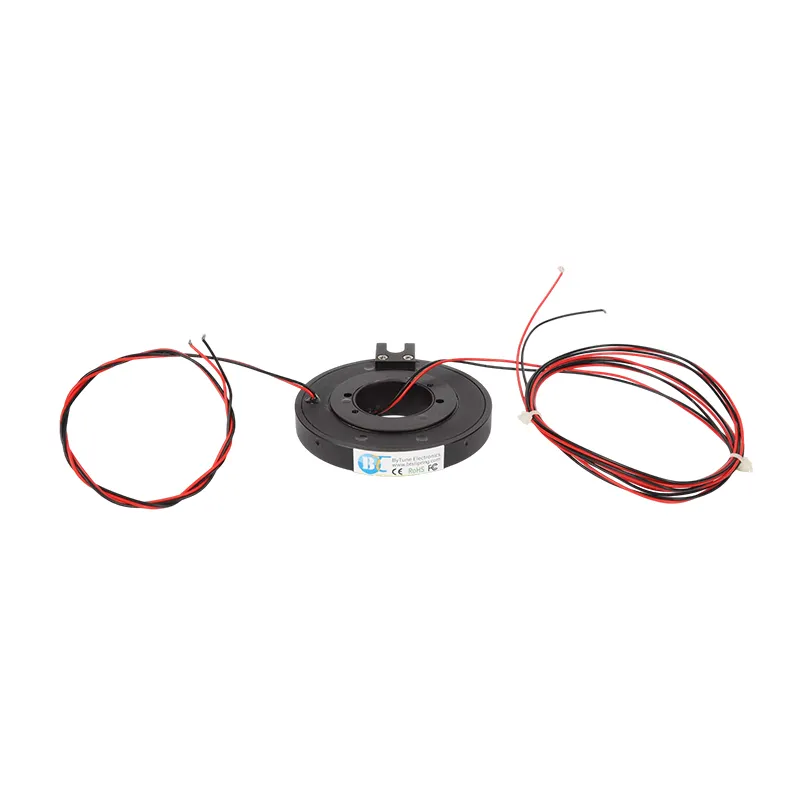
Factors Affecting the Maximum Voltage
The maximum voltage a pancake slip ring can handle isn't a fixed number. It depends on several key factors.
Insulation Material
The insulation material used in the pancake slip ring plays a huge role. Different insulation materials have different dielectric strengths. Dielectric strength is the maximum electric field that an insulating material can withstand without breaking down and conducting electricity. For example, some high - quality pancake slip rings use materials like PTFE (Polytetrafluoroethylene), which has excellent dielectric properties. This allows the slip ring to handle higher voltages compared to those using less - robust insulation materials.
Ring Spacing
The spacing between the conductive rings in a pancake slip ring is also important. If the rings are too close together, there's a higher risk of arcing, especially at high voltages. Arcing occurs when the electrical current jumps across the gap between two conductive elements, which can damage the slip ring and disrupt the electrical connection. So, a well - designed pancake slip ring will have an appropriate ring spacing to prevent arcing at its rated maximum voltage.
Operating Environment
The environment in which the pancake slip ring operates can significantly impact its maximum voltage capacity. High temperatures, humidity, and the presence of dust or corrosive substances can all degrade the insulation and reduce the maximum voltage the slip ring can handle. For instance, in a hot and humid industrial environment, the insulation material might absorb moisture, which can lower its dielectric strength and increase the risk of electrical breakdown.
Typical Maximum Voltage Ranges
Now, let's talk about some typical maximum voltage ranges for pancake slip rings. In general, low - voltage pancake slip rings can handle voltages up to around 24V. These are often used in applications like small robotic arms or consumer electronics, where the power requirements are relatively low.
Medium - voltage pancake slip rings can typically handle voltages in the range of 110V - 480V. These are commonly found in industrial machinery, such as conveyor systems or packaging machines.
High - voltage pancake slip rings are designed to handle much higher voltages, sometimes up to several thousand volts. These are used in specialized applications like high - energy physics experiments or some types of power generation equipment.
Our Product Offerings
As a pancake slip ring supplier, we offer a wide range of products to meet different voltage requirements.
- Our Thin And Light Pcb Pancake Slip Ring is a great option for low - voltage applications. It's designed to be compact and lightweight, making it ideal for use in small - scale equipment.
- The Thin And Light Flat Slip Ring is suitable for medium - voltage applications. It offers reliable performance and is built to withstand the rigors of industrial use.
- If you need a high - voltage solution, our Reliable Disc Slip Ring is the way to go. It's engineered to handle high voltages safely and efficiently.
Testing and Certification
We take the quality and safety of our pancake slip rings very seriously. All of our products undergo rigorous testing to ensure they can handle their rated maximum voltages. We test for factors like insulation resistance, dielectric strength, and arcing at different voltages and environmental conditions.
In addition, many of our pancake slip rings are certified to meet international standards. These certifications give you peace of mind that you're getting a high - quality product that has been thoroughly tested and meets industry - recognized safety and performance criteria.
Choosing the Right Pancake Slip Ring for Your Voltage Needs
When choosing a pancake slip ring for your application, it's important to consider your specific voltage requirements. First, determine the maximum voltage that your equipment will need to operate at. Then, look for a pancake slip ring that has a rated maximum voltage higher than this value to ensure a safety margin.
Also, consider the other factors we mentioned earlier, such as the operating environment and the type of signals or power you'll be transferring. If you're not sure which product is right for you, our team of experts is always here to help. We can provide you with detailed technical information and guide you through the selection process.
Contact Us for Your Pancake Slip Ring Needs
If you're interested in purchasing pancake slip rings or have any questions about their maximum voltage capabilities, don't hesitate to reach out. We're committed to providing you with the best products and services. Whether you need a single pancake slip ring for a small project or a large - scale order for an industrial application, we can meet your needs.
References
- Grover, F. W. (1946). Inductance Calculations: Working Formulas and Tables. Dover Publications.
- Dorf, R. C., & Bishop, R. H. (2013). Modern Control Systems. Pearson.