

Hey there! As a through bore slip ring supplier, I often get asked all sorts of questions about where our products can be used. One question that's been popping up a lot lately is, "Can through bore slip rings be used in virtual reality (VR) devices?" Well, let's dive right into it and find out.
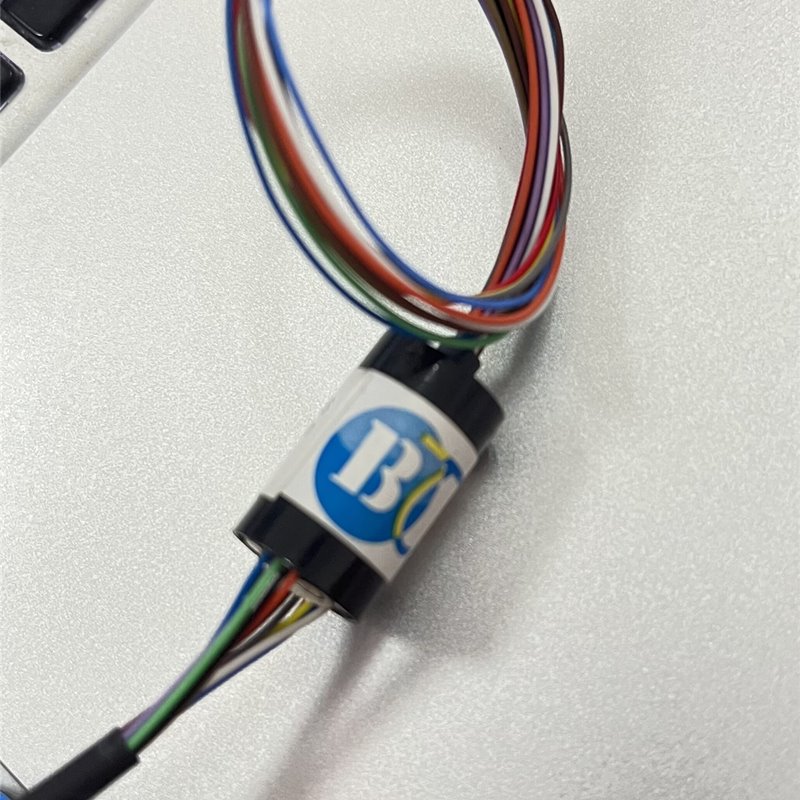
First off, let's quickly go over what through bore slip rings are. In simple terms, a through bore slip ring is a device that allows the transfer of power and electrical signals from a stationary to a rotating structure. It has a hole in the middle, which can be used for various purposes like passing a shaft, cable, or fluid. We offer different types, like the Miniature Through Bore Slip Ring, which is great for applications where space is limited, and the Lager Through Hole Slip Ring, which can handle more complex requirements.

Now, let's talk about VR devices. VR has come a long way in recent years. It's not just for gaming anymore; it's being used in education, healthcare, and even in the military. A typical VR setup consists of a headset, controllers, and sometimes a base station. The headset is the most crucial part, as it creates the immersive experience for the user. It has to track the user's head movements accurately and display high - quality visuals in real - time.
So, can through bore slip rings fit into this picture? Well, there are a few aspects where they could potentially be useful.
1. Rotational Movement in VR Controllers
VR controllers are designed to track the user's hand movements precisely. Some controllers have rotatable parts, like joysticks or wheels. Through bore slip rings could be used here to ensure a continuous flow of electrical signals as these parts rotate. For example, if a controller has a rotating wheel that adjusts a setting in the VR environment, a slip ring can make sure that the electrical connection between the wheel and the main circuit board remains stable. This way, there won't be any signal loss or interruption, which could lead to a glitch in the VR experience.
2. 360 - Degree Rotation in VR Headsets
Some high - end VR headsets are designed to allow for a full 360 - degree rotation. As the user turns their head all the way around, the headset needs to keep sending and receiving data to and from the base station. Through bore slip rings can play a vital role in this scenario. They can be integrated into the headset's design to transfer power and data signals without getting tangled up, even during continuous rotation. This is especially important for applications like virtual tours or immersive training simulations, where a seamless 360 - degree view is essential.
3. Multi - Axis Movement in VR Equipment
In more advanced VR setups, there are often multiple axes of movement. For instance, a VR rig might allow for movement in the x, y, and z axes, as well as rotation. Through bore slip rings can be used to manage the electrical connections across these different axes. They can handle multiple channels of signals, such as video, audio, and sensor data, all at the same time. This means that the VR system can function smoothly, regardless of how complex the user's movements are.
Challenges and Considerations
Of course, using through bore slip rings in VR devices isn't without its challenges.
One major consideration is size. VR devices are usually designed to be as compact and lightweight as possible. So, the slip rings we use need to be small and lightweight too. That's where our Miniature Through Bore Slip Ring comes in handy. It's designed to fit into tight spaces without adding too much weight.
Another challenge is signal quality. In VR, the quality of the signals is of utmost importance. Any interference or noise in the signals can lead to a degraded VR experience. We need to make sure that the through bore slip rings we provide have excellent signal integrity. This means using high - quality materials and advanced manufacturing techniques to minimize signal loss and interference.
Cost is also a factor. VR is a consumer - oriented market, and manufacturers are always looking to keep costs down. We need to find a balance between providing a high - quality product and keeping the price competitive.
Real - World Examples
There aren't a whole lot of VR devices on the market that currently use through bore slip rings, but there are some potential use cases emerging. For example, in VR simulators used for flight training, where the cockpit controls need to have smooth rotational movement. Through bore slip rings can be used to connect the rotating controls to the main simulation system, ensuring accurate data transfer.
Another example is in VR arcade machines. These machines often have large, complex VR setups with multiple moving parts. Through bore slip rings can help manage the electrical connections between the different components, providing a more reliable and immersive experience for the players.
Conclusion
So, to answer the question, yes, through bore slip rings can definitely be used in VR devices. They have the potential to enhance the performance and reliability of VR equipment, especially in areas where rotational movement and multi - axis tracking are involved.
If you're a VR device manufacturer or someone interested in integrating through bore slip rings into your VR project, we'd love to hear from you. We have a wide range of through bore slip rings, including the Through Hole Slip Ring For Satellite Antenna, which can be customized to meet your specific requirements. Whether you need a small, lightweight slip ring for a compact VR headset or a more robust one for a large - scale VR setup, we've got you covered. Reach out to us to start a conversation about how we can work together to take your VR devices to the next level.
References
- Smith, J. (2020). "Advancements in VR Technology." Journal of Virtual Reality Research.
- Brown, A. (2021). "The Role of Electrical Components in VR Devices." Electronics Today Magazine.