


Wind turbine slip ring maintenance keeps pitch control, power transmission, and signal communication stable inside the nacelle. The slip ring itself is a small component, but when it fails it can pull an entire turbine offline. According to NREL wind energy operations research, unplanned downtime is one of the largest cost drivers in wind farm O&M, and electrical sub-components in the nacelle are a recurring contributor.
A turbine slip ring lives in a tough environment: continuous rotation, vibration, temperature swings, brush dust, humidity, oil mist, and salt-laden air offshore. Extending its life is not just about swapping worn brushes. It depends on the combination of routine inspection, dust control, brush wear monitoring, sealing integrity, and selecting a wind turbine slip ring that actually fits the site conditions.
This guide covers why turbine slip rings wear out, what symptoms to look for, how to schedule inspections, how to decide between cleaning, repair and replacement, and what to specify when sourcing a replacement unit.
Why Wind Turbine Slip Ring Maintenance Matters
A turbine only earns revenue when it runs. A slip ring fault inside the hub will often show up first as a pitch control error or a sensor signal drop, and the turbine controller will derate or stop the machine until the fault clears. If the underlying cause is brush wear or contamination, the fault will keep returning.
Good maintenance helps operators:
- Reduce unplanned stops triggered by pitch or hub-signal faults
- Protect the conductive ring surface from secondary damage caused by worn-out brushes
- Catch sealing failures before water or oil reaches the contact path
- Plan brush and slip ring replacement during scheduled service windows instead of emergency callouts
- Avoid the higher service cost of unscheduled climbs, especially offshore
The goal is not to react after failure. It is to detect wear early and keep the slip ring inside a clean, sealed, mechanically stable enclosure.
What a Slip Ring Does in a Wind Turbine
Inside a turbine, the slip ring transfers electrical power and signals between the stationary nacelle structure and the rotating hub. In most modern turbines it sits along the main shaft and serves the pitch control system. For a broader background, see this comprehensive guide to wind turbine slip rings.
Power Transmission for Pitch Control
Turbine blades change angle to match wind speed and to protect the drivetrain in high winds. The pitch system needs stable power for its motors, drives, and battery backup. The slip ring is the only electrical path that crosses the rotating interface. If brush contact pressure drifts, resistance rises and the pitch drives may see voltage dips or trip on undervoltage.
Signal and Data from the Hub
The same slip ring usually carries low-level signals: blade pitch encoders, temperature sensors, vibration sensors, and pitch controller communication. These signals are sensitive to electrical noise. Worn brushes, conductive dust across an insulator gap, or a corroded terminal can introduce intermittent signal loss that the SCADA system will read as a controller fault rather than a slip ring problem. That is why slip ring health belongs in the troubleshooting tree whenever a pitch fault appears only during rotation.
Common Causes of Wind Turbine Slip Ring Failure
Brush Wear and Contact Degradation
Brush wear is normal, but unmanaged brush wear is the most common avoidable cause of slip ring trouble. As brushes shorten, spring force drops, contact pressure becomes uneven, and contact resistance climbs. The result is heat at the contact spot, signal noise, and eventually scoring on the ring surface that no amount of cleaning will recover. The detailed mechanism is covered in this overview of slip ring brush maintenance.

Dust, Oil, Moisture and Contamination
Brush dust is the contaminant operators see first. A thin film is expected. A buildup that bridges adjacent tracks, settles on insulators, or coats sensor signal rings is not normal and usually signals one of three things: overdue cleaning, abnormal brush wear, or a brush material mismatch.
Other contaminants depend on the site:
- Coastal and offshore turbines – salt-laden air accelerates corrosion on exposed metal and ages seals faster than rated. See corrosion protection in marine slip rings for the materials and coating strategies that hold up.
- Desert sites – fine dust penetrates worn gaskets and combines with brush dust to form an abrasive paste on the ring surface.
- Cold and high-altitude sites – temperature cycling drives condensation inside the enclosure if the breather or seals are not properly specified.
- Older turbines – gearbox or pitch hydraulic oil mist can migrate to the slip ring enclosure and shorten brush life.
Vibration, Misalignment and Mechanical Stress
Turbines vibrate. The slip ring shaft must run true with the main shaft. If the coupling slips, the mounting bracket loosens, or cables transmit strain into the housing, you will see uneven brush wear on one side of the ring stack, premature bearing noise, or a brush that wears in a tapered pattern. None of these clear by cleaning.
Incorrect Maintenance and Physical Misuse
In field inspections, a recurring finding is mechanical damage caused by technicians using the slip ring as a step or grab handle when working in the hub. Other avoidable mistakes include blowing dust deeper into the assembly with high-pressure air, bending cables sharply at the housing entry, and skipping the OEM-specified torque on terminal screws.
Wind Turbine Slip Ring Failure Symptoms: Early Warning Signs
Most slip ring failures announce themselves before they take a turbine offline. Train technicians to recognise these signs during scheduled service.
Intermittent Pitch or Sensor Signal Loss
A signal that drops only while the rotor is turning, or only at certain rotor positions, points to a contact issue rather than a controller issue. Repeat fault codes that clear on restart are a classic slip ring symptom.
Abnormal Brush Dust Buildup
A light, evenly distributed grey film is normal. Heavy, uneven, or oily dust is not. Dust bridging between tracks or settling on signal contacts will eventually cause leakage current and noise.
Visible Wear, Heat Marks or Corrosion
During inspection look for discoloured ring surfaces, blue or brown heat marks, cracked insulation between tracks, green or white oxidation on terminals, and any sign of moisture trails inside the enclosure. The catalogue of slip ring wear causes and signs gives a useful visual reference.
Unusual Electrical Noise or Repeated Control Faults
If pitch control faults keep returning after a software reset or a controller swap, measure contact resistance and insulation resistance at the slip ring before replacing more expensive electronics.
Wind Turbine Slip Ring Maintenance Schedule
Inspection frequency should follow the turbine OEM's service manual, the slip ring manufacturer's manual, and the site's environmental conditions. The schedule below is a typical reference for onshore turbines under normal duty. Adjust based on operating hours, fault history, and site exposure.
| Maintenance Type | Typical Interval | Scope |
|---|---|---|
| Routine visual inspection | Every scheduled turbine service (typically 6–12 months) | Brush wear, dust level, enclosure condition, cable strain relief, terminal tightness |
| Scheduled cleaning | Annual or as dust level indicates | Remove brush dust, inspect insulator surfaces, check seals |
| Brush replacement | Per manufacturer wear limit, often 3–7 years depending on brush material and duty | Replace before brush reaches minimum length; inspect ring surface |
| Condition-based maintenance | Triggered by fault codes or signal anomalies | Measure contact resistance, insulation resistance, inspect specific tracks |
| Emergency troubleshooting | On fault | Localise fault to slip ring vs controller vs cable; document and plan repair |
| Replacement planning | End of life or repeated failure | Specify replacement unit, schedule service window, prepare spare and lifting plan |
Coastal, offshore, and desert turbines normally need shorter intervals between the visual and cleaning steps. IEC 61400-series wind turbine standards set the broader framework for design and service requirements, but the actual numbers come from the OEM and slip ring vendor manuals.
How to Maintain Wind Turbine Slip Rings: 6 Practical Steps
Step 1: Run a Structured Visual Inspection
Open the enclosure during scheduled service. Photograph the inside before touching anything. Then check, in order: brush length against the wear mark, dust colour and distribution, ring surface for scoring or discolouration, insulator gaps for dust bridging, terminals for oxidation, cables for chafing, and seals for cracks or compression set.
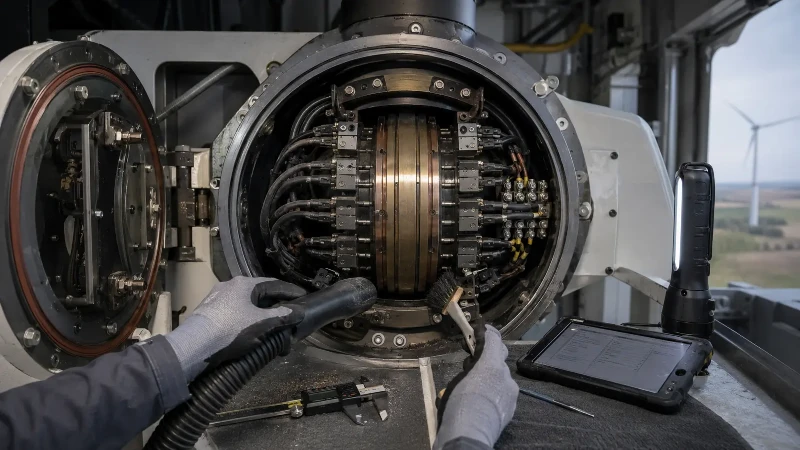
Step 2: Remove Brush Dust Without Spreading It
Use a small ESD-safe vacuum or a soft brush, not high-pressure compressed air, unless the manufacturer specifically approves it. Compressed air pushes conductive dust into bearings, behind insulators, and onto sensor signal tracks where it is hardest to remove. If air is used, it should be dry, oil-free, low pressure, and directed outward.
Step 3: Keep the Enclosure Clean and Properly Sealed
If you find repeated contamination, cleaning is not the fix. The seal, breather, or cable gland is leaking. Replace gaskets, check the IP rating of cable glands, and confirm the breather (if fitted) is functioning. For background on sealing classes, see this explanation of slip ring IP ratings, and for sealed designs see waterproof slip ring design.
Step 4: Monitor Brush Wear Before It Reaches the Limit
Replace brushes before they hit the wear line, not after. A brush that runs to the spring will scratch the ring surface, and that damage usually requires full slip ring replacement. If the slip ring uses a modular brush block, replace the full block as a set so contact pressure stays uniform. Record brush length at every inspection so you can predict the next replacement window.
Step 5: Verify Cable Connections and Mechanical Mounting
Loose terminals and cable strain are responsible for a surprising share of "slip ring failures" that turn out to be wiring faults. Torque terminals to spec, check the cable bending radius at the housing entry, confirm mounting bolt torque, and look for vibration witness marks on the bracket.
Step 6: Protect the Slip Ring from Physical Misuse
Label the slip ring housing so it is not used as a step or handhold. This single change prevents a category of damage that no maintenance plan can catch in advance.
Wind Turbine Slip Ring Troubleshooting Table
| Symptom | Likely Slip Ring Cause | Recommended Action |
|---|---|---|
| Intermittent pitch signal, only while rotating | Brush dust on signal track or worn signal brush | Inspect signal track, clean enclosure, check brush length |
| Pitch drive trips on undervoltage | High contact resistance on power circuit | Measure contact resistance, inspect brush pressure and ring surface |
| Repeated controller fault that clears on restart | Marginal contact or conductive dust bridging an insulator | Clean, measure insulation resistance, recheck |
| Heat marks or discoloured ring | Localised high resistance or arcing | Replace brush block; assess ring surface for replacement |
| Tapered or one-sided brush wear | Shaft misalignment or loose mounting | Check coupling, mounting, and bracket torque |
| Oil or water inside the housing | Failed seal, gland, or breather | Find leak source, replace gasket and gland, then clean |
| Green or white deposits on terminals | Corrosion, often from moisture or coastal air | Clean terminals, verify sealing, consider corrosion-protected unit at next replacement |
| Bearing noise from slip ring assembly | End-of-life bearing or contamination ingress | Plan slip ring replacement |
Clean vs Repair vs Replace: How to Decide
When Cleaning Is Enough
- Dust buildup is light and contact surfaces are still smooth
- No recurring fault codes are logged
- No corrosion, water or oil is visible
- Brushes have usable wear life remaining
- Seals and cable entries are intact
When Brush Replacement Is Needed
- Brushes are at or near their wear limit
- Wear is uneven across the brush block
- Contact pressure measurements are out of spec
- Signal noise or intermittent faults appear with otherwise healthy rings
- The manufacturer's recommended interval has been reached
When Full Slip Ring Replacement Is the Right Call
- Ring surface is scored, pitted, or heat-damaged
- Insulation resistance has dropped and cleaning does not recover it
- Corrosion has reached internal components
- Bearings are noisy or rough
- The same fault returns after cleaning and brush replacement
- The current slip ring does not match the site conditions and keeps failing early
If you are replacing a slip ring more than once in the same turbine, the unit is probably under-specified for the site. The next section covers what to change.
How to Choose a Replacement Wind Turbine Slip Ring
Buying a like-for-like replacement is the right move only if the original lasted its rated life. If it did not, treat the replacement as a re-specification, not a substitution. The key parameters to confirm:
- Number of power circuits and current rating per circuit – match pitch drive load including peaks, not just continuous rating.
- Signal channels and signal type – encoder, Ethernet, CAN bus, RS-485, analogue sensors; each has different shielding and contact requirements.
- Voltage rating and insulation class – including the gap between power and signal tracks.
- Rotation speed – pitch slip rings see low RPM but high duty cycles; confirm brush life at the actual duty.
- Operating temperature range – cold climates need brush materials and lubricants rated for low temperatures.
- IP rating and sealing – IP65 or higher is common for turbine hubs; offshore typically demands more.
- Corrosion protection – stainless hardware, coated housings, and sealed cable entries for marine and coastal sites.
- Brush design and serviceability – modular replaceable brush blocks reduce service time, especially at remote and offshore sites.
- Mounting dimensions and shaft interface – verify against the existing bracket and coupling.
- Cable exit, connector type, and cable length – pre-terminated assemblies cut commissioning time inside the hub.
For non-standard requirements, most failures can be designed out with a customized slip ring built around the actual circuit list, IP class, and brush serviceability the site needs.

How Slip Ring Design Affects Service Life
Maintenance reduces avoidable failures. Design decides how often maintenance is needed in the first place.
- Brush material – metal-graphite, silver-graphite, and precious-metal fibre brushes generate different amounts of dust at different current densities. The right choice depends on the circuit, not the catalogue default.
- Modular brush blocks – let a technician replace brushes in minutes during a planned outage instead of swapping the whole slip ring.
- Sealing and breather design – the difference between an enclosure that stays dry for ten years and one that condenses inside every winter.
- Corrosion-resistant housings – anodised aluminium or stainless steel with sealed cable glands for offshore and coastal sites.
- Signal shielding and track separation – physical and electrical isolation between power and signal circuits to keep pitch encoder data clean.
- Bearing rating and lubrication – matched to actual duty, not just rotation speed.
A slip ring specified once for the actual site conditions almost always costs less over the turbine lifetime than a cheaper unit that gets replaced twice.
FAQ: Wind Turbine Slip Ring Maintenance
Q: How Often Should Wind Turbine Slip Rings Be Inspected?
A: Follow the turbine OEM's service interval as the baseline, then adjust based on site exposure and fault history. Coastal, offshore, and dusty sites usually need more frequent visual checks than the OEM minimum.
Q: What Are The Most Common Wind Turbine Slip Ring Failure Symptoms?
A: Intermittent pitch signal loss during rotation, recurring controller faults that clear on restart, heavy or uneven brush dust, visible heat marks on the rings, and unusual noise from the slip ring assembly.
Q: Can Brush Dust Cause Signal Problems?
A: Yes. Conductive brush dust bridging adjacent tracks or settling on signal contacts causes leakage current and electrical noise, which the controller often reports as a sensor or communication fault rather than a slip ring fault.
Q: When Should Slip Ring Brushes Be Replaced?
A: Before they reach the wear limit marked on the brush or specified in the manual. Replacing late risks damaging the ring surface and forcing a full slip ring replacement.
Q: Is Cleaning Enough To Fix A Failing Wind Turbine Slip Ring?
A: Only if the rings are still smooth, insulation is intact, and brushes have life left. If contact surfaces are scored, insulation has degraded, or moisture has reached the contacts, cleaning is a temporary measure at best.
Q: What Should You Check Before Replacing A Wind Turbine Slip Ring?
A: Confirm that the fault is actually inside the slip ring, not in the cable, terminal, or controller. Measure contact resistance and insulation resistance, inspect the ring surface, and review the fault history. Then verify circuit count, current rating, signal type, IP rating, and mounting dimensions for the replacement.
Q: Which Slip Ring Design Is Better For Harsh Wind Turbine Environments?
A: For offshore and coastal sites, a higher IP rating, corrosion-resistant housing, sealed cable glands, and brush materials that minimise dust are usually worth the cost. For desert sites, dust ingress protection and brush material choice matter most. For cold sites, breather design and low-temperature lubricants are the priority.
Q: How Do Sealed And Modular Slip Rings Reduce Maintenance Frequency?
A: Properly sealed enclosures keep moisture, salt air, and fine dust away from the contact path, which is where most degradation starts. Modular brush blocks let technicians replace wear parts in a single planned outage instead of swapping the entire unit, which matters most at remote and offshore sites where every climb has a cost.
Q: When Is Repeated Brush Wear A Sign Of Poor Slip Ring Specification?
A: If brushes wear out well before the manufacturer's expected life, or if the same turbine consumes brushes faster than its sister turbines, the slip ring is probably under-rated for the actual current, duty cycle, or environment. Re-specifying at the next replacement is more cost-effective than continuing to swap brushes.
Conclusion
Extending wind turbine slip ring life is a combination of two things: a maintenance plan that catches wear early, and a slip ring designed for the actual site. Routine inspection, careful dust control, brush wear tracking, sealing checks, and a maintenance log will catch most problems before they reach the controller. Specifying the right unit at the next replacement closes the loop.
If your turbines are seeing repeated brush wear, recurring pitch faults, or contamination that keeps coming back after cleaning, the slip ring specification is probably part of the problem. Engineering teams that build to the actual circuit list, IP class, and brush serviceability the site needs can review the existing unit and propose a replacement designed to outlast it. Talk to a wind turbine slip ring engineer with your circuit list, site conditions, and failure history, and ask for a replacement specification rather than a part-number match.