

Overview
In today's era of rapid technological development, slip rings are used to transmit electricity and signals in numerous rotating devices. This ranges from industry equipments to medical CT equipment, as well as the surveillance cameras commonly seen on the roads. But do you know that these slip rings have different numbers of wires inside, such as 2-wire, 6-wire, and 12-wire? In this text, we'll explore the characteristics, applicable scenarios, etc. of these different types of wire configurations together. This can help you make a better choice when selecting a slip ring.
What Means the Wire of Slip Ring?
In rotating equipment, slip rings use fixed brushes and rotating metal rings to conduct electricity or signals. They can transfer the alternating electromotive force induced in the rotating coil to an external circuit. These wires are the fixed conductors used to achieve this transfer. During installation, each slip ring is connected to one end of the coil wire and is electrically connected to the external circuit through a conductive carbon brush.
These wires support the transmission of various types of currents and signals, such as common direct current (DC), alternating current (AC), as well as analog signals and digital signals. Thanks to these wires, the rotating equipment can operate normally.
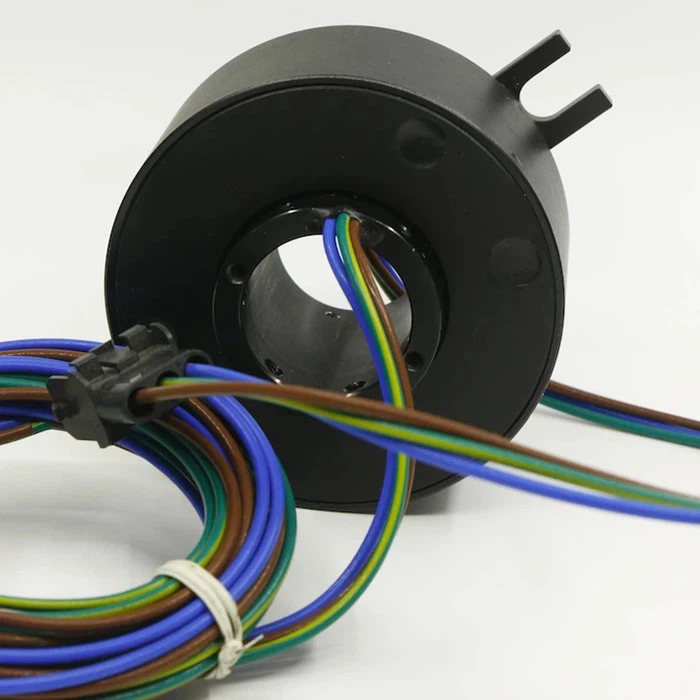
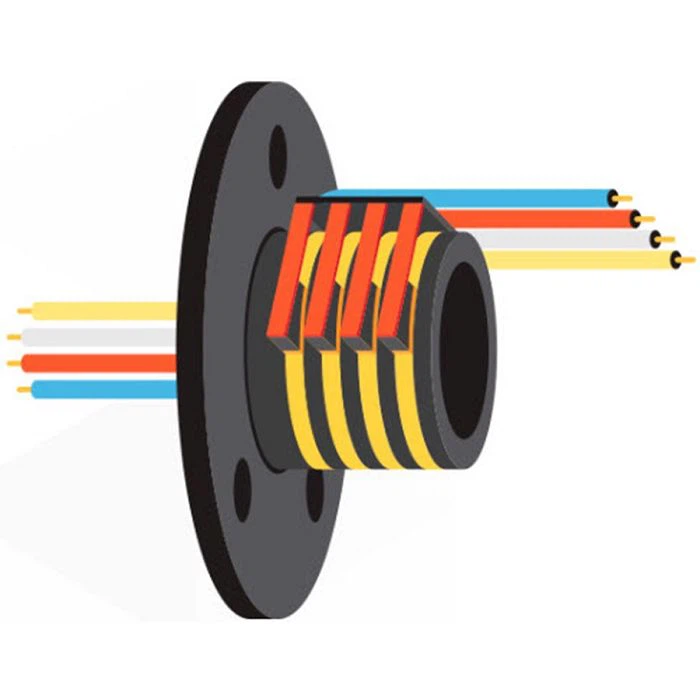
Comparison of Slip Rings with Different Wires
|
Items |
2 wire slip ring |
3 wire slip ring |
6 wire slip ring |
12 wire slip ring |
|
Conductors Number |
only 2 conductors |
3 conductors |
6 conductors |
up to 12 conductors. |
|
Transmission capacity |
mainly power the positive and negative poles of small motors, with current not exceed 1A |
positive and negative poles of the power supply, and another simple signal, the current can reach 2-3A |
simultaneously transmits multiple power supplies and control signals, feedback signals, etc., and can withstand 5-10A current |
ultra-complex signal transmission, such as high-speed data of medical imaging equipment, carrying current of more than 10A |
|
Slip ring size |
compact in size, with an outer diameter ranging from 10 - 20mm |
15-30mm outer diameter, slightly larger than the 2 wire slip ring |
30-50mm outer diameter, and the volume is relatively large |
50 - 80mm outer diameter, large volume. |
|
Advantage |
low cost, easy to install and maintain |
can handle multiple signals and power lines at the same time |
strong transmission capacity, can transmit data in parallel |
rich transmission channels, can be used in complex industrial or mechanical systems |
|
Limitations |
cannot carry multiple channels or circuits |
larger size becomes larger and the integration is reduced |
the size becomes larger, not suitable for small equipment |
manufacturing and maintenance become more difficult, requiring professional technical support |
|
Application |
lower cost and affordable price |
industrial machinery, telecommunications equipment, automation and control systems |
robots, industrial machinery, PTZ equipment and monitoring systems |
CT scanners, industrial machinery |
How to Choose Slip Rings with Different Wires for Your Application?
Now that we've understood the differences among slip rings with different numbers of wires, do you know how to choose the right one for your application? Here are some of our suggestions for selection:
Current and Voltage Levels
Small, low - power devices only need low - voltage DC power supply, like small electric toys. Ordinary 2 - 3 wire slip rings can meet their current transmission requirements. However, large industrial motors need high - voltage AC power to operate, and we should look for slip rings with a higher configuration.
Signal Transmission Rate
If only simple switch signals are being transmitted, then 2 - 3 wire slip rings are sufficient. But in the operation of high - definition monitoring pan - tilt units, multiple signals such as video signals and control signals are involved. They also require an extremely high transmission rate to maintain the smoothness and clarity of the video. In such cases, 6 - 12 wire slip rings are needed.
Consideration of Equipment Space
Medium - sized and small equipment such as turbines, CCTV cameras, and industrial motors have limited internal space. They often use more compact 3 - wire slip rings. Automated industrial equipment and wind turbines have higher requirements for the load - bearing capacity of slip rings. At this time, 6 - 12 wire slip rings are a better choice.
Budget Constraints
If your project budget is limited and the electrical requirements of the equipment are relatively simple, choose 3 wire slip rings. These types of slip rings are relatively low in cost and can also meet basic usage requirements. Conversely, you can consider 6 - 12 wire slip rings.
Our Custom Options
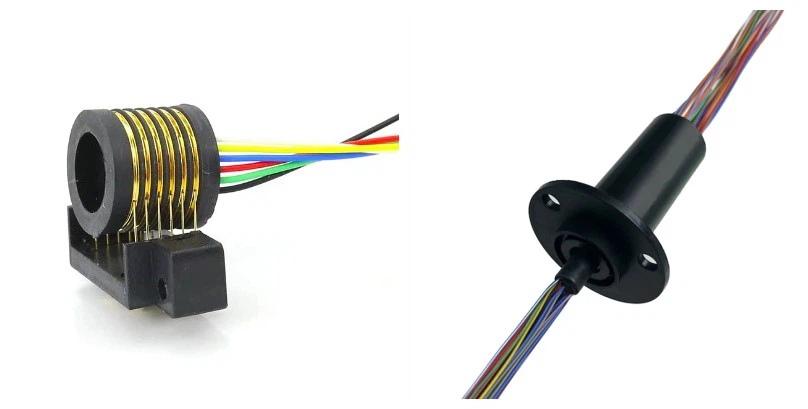
ByTune designs any single or combined wiring configurations for your slip rings.This including 2 up to124 wires, like our 124 Wires Low Torque Multi-circuit Capsule Slip Ring With OD 54mm. This will enable your machinery to adapt to operations in various environments. We also offer the following options:
Cables
• Solid - core cable
• Stranded cable
• CAT cable
• Coaxial cable
• Shielded cable
Ring terminal
• Sealed flying line
• Military specification connector
• Coaxial connector
Installation
• Shaft end installation
• Through hole installation
• Flange installation
Conclusion
As we can see now, the number of wires in a slip ring affects its size, transmission capacity, applicable scope, and so on. Among them, 2 - 3 wire slip rings are suitable for simple and low - cost applications, while 6 - 12 wire slip rings are the opposite. If you are interested in them, please feel free to contact us, and you can get the cusotom slip ring solution that best suits your application.