

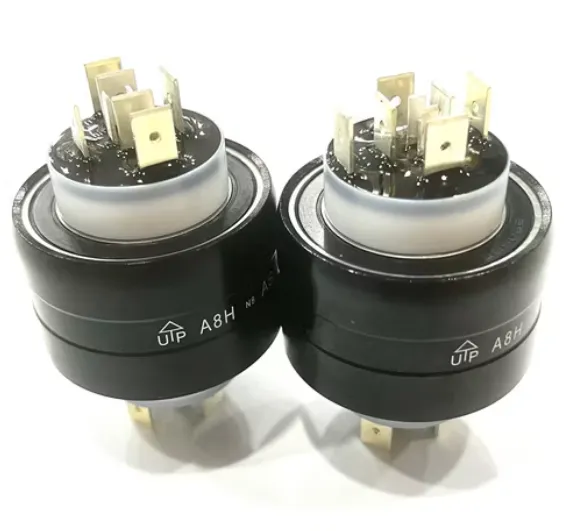
How Does Mercury Slip Ring Work?
A mercury slip ring uses liquid mercury as a conductive medium to transfer electrical signals and power between stationary and rotating components. Unlike conventional slip rings that rely on carbon brushes sliding against metal rings, mercury slip rings employ pools of liquid mercury that remain in molecular contact with both stationary and rotating elements during operation.
The Core Operating Principle
The fundamental mechanism relies on mercury's unique properties as a liquid metal conductor. Inside the slip ring housing, small pools of mercury are contained in sealed chambers. Metal contact pins from the rotating shaft dip into these mercury pools, while stationary contacts connect to the opposite side of the same pools. When the shaft rotates, the pins move through the liquid mercury, which acts as a continuous conductive bridge maintaining the electrical pathway without any solid-to-solid friction.
This liquid-based contact system distinguishes mercury slip rings from their conventional counterparts. Traditional slip rings experience constant mechanical wear as carbon or metal brushes scrape against rotating rings. Mercury eliminates this friction entirely since liquid mercury flows and reforms around the moving contacts rather than resisting them.

Internal Construction and Components
The assembly consists of several precisely engineered parts working together. The outer housing, typically machined from aluminum alloy or stainless steel, provides structural support and environmental protection. Inside, individual mercury chambers are arranged coaxially around the central shaft, with each chamber handling one electrical circuit.
Sealing technology is critical to the design. Special gaskets and barriers prevent mercury from leaking while accommodating the thermal expansion and contraction that occurs during operation. The contact pins are manufactured from materials that form strong molecular bonds with mercury, ensuring stable electrical connection even during high-speed rotation.
The rotor section attaches directly to the rotating machinery shaft, carrying the contact pins that remain submerged in the mercury pools. The stator section houses the mercury reservoirs and external electrical connections. Both sections must maintain precise alignment to prevent uneven contact or mechanical stress that could compromise the seal integrity.
Electrical Conduction Through Liquid Metal
Mercury's exceptional conductivity makes it ideal for this application. With electrical resistance below 1 milliohm, mercury provides a pathway that surpasses carbon brushes by orders of magnitude. This translates to minimal voltage drop across the contact interface, critical for applications requiring precise signal transmission or high current capacity.
The molecular bonding between mercury and the metal contacts creates a gas-tight, oxide-free interface. Unlike solid metal contacts that develop surface oxidation and contamination over time, mercury's liquid nature constantly presents a fresh, clean conductive surface. This characteristic maintains consistent electrical performance throughout the device's operational life.
Temperature plays an important role in mercury slip ring operation. Mercury remains liquid from approximately -39°C to 357°C, providing a practical operating range for most industrial environments. However, the working temperature typically stays below 60°C to prevent excessive thermal expansion and ensure seal reliability.
Contact Resistance and Signal Integrity
One of the most significant advantages emerges in the contact resistance characteristics. Conventional slip rings exhibit variable contact resistance as brushes wear, accumulate debris, or experience vibration-induced momentary disconnection. These variations introduce electrical noise and signal degradation, particularly problematic in sensitive instrumentation and data transmission applications.
Mercury slip rings maintain contact resistance consistently below 1 milliohm across their entire service life. The liquid contact eliminates bounce, chatter, and micro-interruptions that plague mechanical contacts. This stability proves essential in applications like medical imaging equipment, where signal purity directly affects diagnostic accuracy, or precision sensors transmitting thermocouple and strain gauge readings.
The near-zero electrical noise characteristic stems from the absence of mechanical contact variations. In conventional slip rings, the brush-to-ring interface constantly changes microscopically as it rotates, generating electrical noise across a broad frequency spectrum. Mercury's fluid contact produces virtually no such variation, resulting in noise levels measured in microvolts rather than millivolts.
Rotational Dynamics and Friction Characteristics
Friction reduction represents another fundamental advantage. Conventional slip rings require spring-loaded brushes pressing against rotating rings, creating continuous mechanical resistance that generates heat, causes wear, and limits rotational speed. The contact pressure must be carefully balanced-too little pressure causes intermittent connection, while excessive pressure accelerates wear.
Mercury slip rings operate with essentially zero friction at the contact interface. The liquid mercury parts smoothly as the contact pin moves through it, requiring no mechanical pressure. This frictionless operation enables several benefits: unlimited rotation without cable twist concerns, higher rotational speeds without excessive heating, extended operational life without performance degradation, and reduced torque requirements for the rotating machinery.
The rotational speed capability reaches into thousands of RPM depending on the specific design. Centrifugal forces at high speeds can affect mercury distribution within the chambers, so advanced designs incorporate features to maintain proper mercury coverage across the contact area even during rapid rotation.

Multi-Circuit Configuration
Most applications require transferring multiple electrical circuits simultaneously. Mercury slip rings accommodate this through stacked or concentric chamber arrangements. Each circuit occupies its own isolated mercury pool with dedicated contact pins and external connections.
A typical mercury slip ring might include 2 to 12 separate circuits, each rated for specific current and voltage levels. Power circuits carrying 30 amperes or more occupy larger chambers with proportionally more mercury volume, while signal circuits handling milliamp-level currents use smaller chambers. The modular nature allows customization to match exact application requirements.
Circuit isolation between adjacent chambers is maintained through physical barriers and careful spacing. Unlike conventional slip rings where adjacent circuits can experience crosstalk through capacitive or inductive coupling, the individual mercury pools provide excellent electrical isolation when properly designed.
Limitations and Operating Constraints
Despite their advantages, mercury slip rings impose certain constraints. The most significant limitation involves temperature boundaries. Mercury solidifies at -39°C, making these devices unsuitable for arctic or cryogenic applications. At the upper end, operating temperatures above 60°C risk seal degradation and excessive mercury vapor pressure.
Installation orientation matters significantly. Mercury slip rings must be mounted vertically with the "UP" direction clearly marked and maintained during both operation and storage. Incorrect orientation allows mercury to pool improperly, potentially breaking electrical contact or stressing seals. This requirement limits flexibility in equipment design compared to conventional slip rings that function in any orientation.
Vibration and mechanical shock can temporarily disrupt the liquid mercury contact, causing momentary signal interruption. While the mercury quickly reestablishes contact, applications involving severe vibration or impact loads may not be suitable. The mounting must isolate the slip ring from external mechanical loads while providing rigid shaft coupling.
High-frequency signal transmission presents challenges for mercury slip rings. The capacitance and inductance characteristics of liquid mercury contact limit effective bandwidth, making them unsuitable for Ethernet, high-frequency RF signals, or other applications requiring multi-megahertz bandwidth. Conventional fiber optic or specialized high-frequency slip rings serve these applications better.
Safety Considerations in Mercury Handling
Mercury's toxicity necessitates careful handling throughout the device lifecycle. Manufacturers seal the mercury completely within the housing using advanced gasket technology and mechanical fasteners that prevent accidental opening. Under normal operation, users never encounter liquid mercury directly.
Installation procedures prohibit soldering directly to the slip ring terminals, as excessive heat could compromise seals. Connection methods use mechanical terminals or pre-attached cable assemblies. The housing integrity must be maintained-any damage suggesting seal compromise requires immediate removal from service and proper disposal.
Workplace safety protocols mandate that personnel working with mercury slip rings receive training on recognition of potential mercury exposure and emergency response procedures. While properly functioning units pose minimal risk, damaged equipment requires specialized cleanup following hazardous material protocols. Many regions prohibit disposing of mercury-containing devices in regular waste streams.
The global movement toward reducing mercury usage has prompted manufacturers to develop non-mercury alternatives using proprietary liquid metal alloys or advanced contact technologies. These alternatives aim to match mercury's performance while eliminating environmental and health concerns.
Maintenance Requirements and Lifespan
One of the compelling advantages of mercury slip rings is their maintenance-free operation. Conventional slip rings require periodic brush replacement, contact cleaning, and performance monitoring. Brush wear generates conductive debris that must be removed to prevent short circuits or tracking between adjacent circuits.
Mercury slip rings eliminate these maintenance tasks. The absence of wear means no consumable parts to replace. The liquid mercury maintains consistent properties indefinitely, assuming seal integrity is preserved. Properly installed and operated mercury slip rings can function continuously for years without intervention.
Lifespan typically exceeds conventional slip rings by significant margins. While brush-type slip rings might require service every 500 to 2,000 hours of operation depending on application severity, mercury slip rings commonly operate for tens of thousands of hours without performance degradation. Some installations report mercury slip rings functioning reliably for over two decades.
Periodic inspection focuses on external factors: cable connections remain secure, mounting alignment hasn't shifted, housing shows no signs of impact damage or corrosion, and environmental conditions remain within specifications. These simple checks take minutes compared to the labor-intensive maintenance required for brush-type systems.
Applications Across Industries
Medical imaging equipment represents a critical application domain. CT scanners and MRI machines require continuous rotation while transmitting high-fidelity signals from sensors and power to moving components. The electrical noise from conventional slip rings would degrade image quality, while mercury slip rings provide the clean signal transmission essential for accurate diagnosis.
Wind turbine generators utilize mercury slip rings to transfer power from rotating blade assemblies to stationary power conditioning equipment. The combination of outdoor environmental exposure, continuous operation, and high power requirements aligns well with mercury slip ring capabilities. The long maintenance-free lifespan reduces service costs in these difficult-to-access installations.
Industrial automation and robotics benefit from the unlimited rotation capability. Robotic arms requiring continuous rotation in one direction would quickly bind conventional cabling. Mercury slip rings enable unrestricted rotation while maintaining reliable power and data connections. The compact size allows integration into space-constrained robotic joints.
Military and aerospace applications demand the highest reliability under demanding conditions. Radar systems, satellite communication equipment, and missile guidance systems employ mercury slip rings where signal integrity and long-term reliability outweigh cost and weight considerations. The ability to withstand high rotational speeds and harsh environments proves valuable in these applications.
Packaging machinery, winding equipment, and rotating tables in manufacturing facilities use mercury slip rings for their high-speed capability and maintenance-free operation. Production environments where downtime carries significant cost penalties particularly value the reliability advantage.
Comparison With Alternative Technologies
Conventional carbon brush slip rings cost less initially and operate in any orientation without mercury's toxicity concerns. They suit applications with limited rotation, lower speeds, or where periodic maintenance is acceptable. However, they cannot match mercury slip rings for electrical performance, maintenance requirements, or operational lifespan.
Fiber optic rotary joints transfer optical signals across rotating interfaces, eliminating electrical contact entirely. They excel in high-bandwidth data transmission but cannot handle electrical power transfer. Applications requiring both power and data often combine fiber optic rotary joints with mercury slip rings.
Wireless slip rings use inductive or capacitive coupling to transfer power and signals without physical contact. They eliminate wear entirely and function in very harsh environments. However, power transfer capacity remains limited compared to mercury slip rings, and efficiency decreases with higher power levels. The technology suits low to moderate power applications where contact-free operation justifies the cost premium.
Through-bore slip rings, pancake slip rings, and separate slip rings represent configuration variations rather than fundamental technology differences. Mercury slip rings are available in these various configurations to match specific mechanical integration requirements.
Frequently Asked Questions
How long do mercury slip rings last?
Mercury slip rings typically last 20,000 to 50,000 hours of continuous operation or longer, significantly exceeding conventional slip ring lifespans. The absence of mechanical wear means they don't degrade over time when properly installed and maintained within specified operating conditions. Some installations report mercury slip rings operating reliably for decades.
Can mercury slip rings transmit Ethernet signals?
Mercury slip rings are not suitable for Ethernet transmission. The electrical characteristics of liquid mercury contacts limit bandwidth to frequencies well below the multi-megahertz requirements of Ethernet protocols. Specialized capsule slip rings or fiber optic rotary joints handle Ethernet and other high-frequency signals more effectively.
What happens if a mercury slip ring leaks?
Mercury leakage represents a serious hazardous material situation requiring immediate response. The affected area must be evacuated, ventilated, and cleaned following mercury spill protocols. Professional hazmat cleanup is typically required. Properly designed and maintained mercury slip rings contain multiple seal barriers making leakage extremely rare during normal operation.
Why must mercury slip rings be mounted vertically?
Vertical mounting ensures mercury pools properly within the contact chambers. Incorrect orientation causes mercury to migrate away from contact areas, breaking electrical connection. The liquid nature of mercury means gravity significantly affects its distribution within the housing, unlike solid contacts in conventional slip rings that function in any orientation.